The Dubai Dream: Jamaica's Ambition to Become a Global Living Destination — and the Hard Realities That Stand Between Vision and Reality

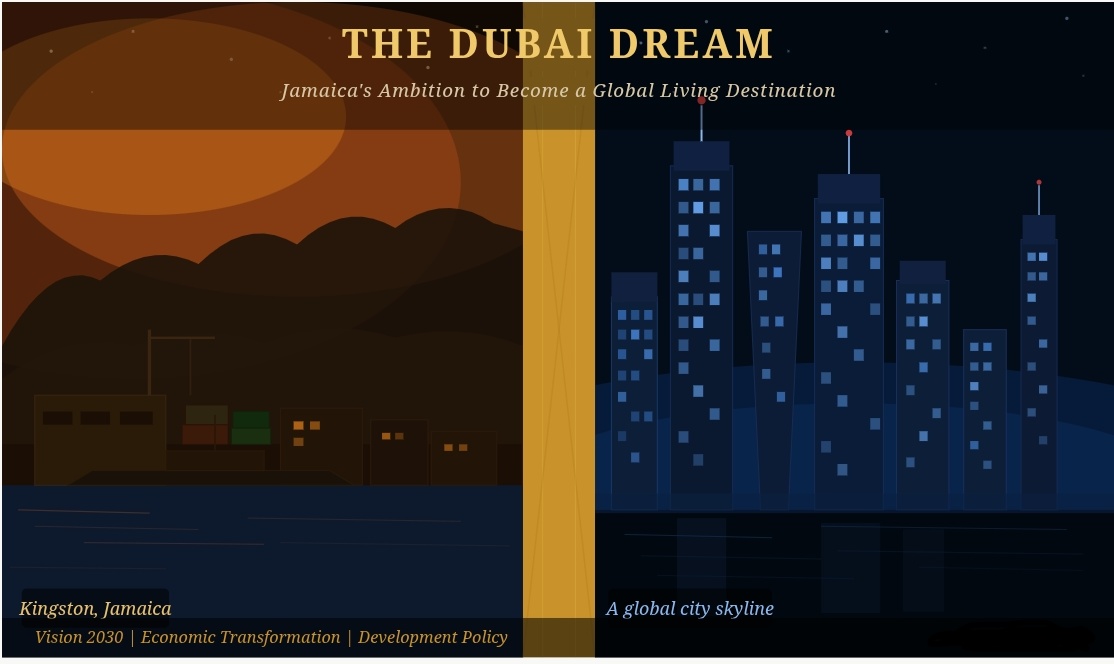
Prime Minister Andrew Holness wants the world to choose Jamaica — not just visit it. But as the island benchmarks itself against two of the most remarkable economic transformations in modern history, the gap between aspiration and infrastructure has never been more visible.
I. The Crossroads
Fifty miles wide and a hundred and fifty miles long, Jamaica punches far above its economic weight in the global imagination. Its music colonised the world. Its athletes redefined what human speed could look like. Its cuisine, its language, its cultural fingerprints appear on virtually every continent. And yet, for most of its post-independence history, the island's defining economic export has been its own people.
That may be changing — or at least, there is a serious political will to make it change.
At the Jamaica Chamber of Commerce 41st Annual Awards Banquet in June 2026, Prime Minister Dr Andrew Holness delivered a speech that stepped back from day-to-day policy and reached for something more ambitious: a reimagining of what Jamaica is for. Not a stopover. Not a beach holiday. A place where people from around the world — retirees, investors, entrepreneurs, skilled workers — choose to plant roots, build businesses, and spend not five days but five decades.
His reference points were deliberate and striking: Dubai. Singapore. Two of the most breathtaking economic transformations of the twentieth and twenty-first centuries.
"Jamaica could become Dubai or Singapore," Holness told the gathering. "Where we are today, it is totally different from the 70s."
The statement drew attention. It deserves scrutiny. Because the distance between Jamaica's current economic reality and the world those two cities inhabit is not measured in miles. It is measured in decades of institutional investment, governance discipline, strategic geography, and policy choices made at the highest levels of state — choices that were not always democratic, not always equitable, and not always replicable.
This article does not dismiss the vision. It takes it seriously enough to examine what it would actually require.
II. What the Vision Actually Means
The shift Holness is proposing is not merely rhetorical. It has specific economic implications that deserve unpacking.
Jamaica's current development model is built substantially around tourism. The sector accounts for roughly 22 percent of GDP, and by 2025, the island was on track to welcome close to five million visitors annually, with tourism earnings approaching US$5 billion. These are impressive numbers for an economy of Jamaica's size — but they represent a structurally fragile foundation.
Tourism revenue is circular, seasonal, externally-driven, and disproportionately captured by foreign-owned hotel chains and resort operators. The five-day visitor generates spending; they do not generate compounding economic activity. They do not hire locally over the long term, build institutional knowledge, pay income tax, or create supply chains. They leave.
What Holness is proposing is a shift toward residential economic activity — people who arrive and stay. In economic terms, this means anchoring GDP growth in consumption, investment, employment, and property markets driven by long-term residents, not episodic tourists. It means attracting foreign direct investment not just in hospitality but in financial services, logistics, technology, and healthcare. It means creating conditions under which the Jamaican diaspora — estimated at over three million people globally, with remittances accounting for 17.4 percent of GDP in 2024 — chooses to return rather than send money home from afar.
Holness also signalled an openness to importing labour for an economy approaching full employment. With Jamaica's unemployment rate at a historic low of 3.6 percent in January 2026, business leaders were already telling him they could not find workers. He pointed to Cayman and Antigua as regional examples of economies that had drawn on imported labour to sustain growth — economies built, in no small part, on Jamaican workers themselves.
The irony was not lost in the room.
III. Why Dubai and Singapore
Dubai and Singapore were not always what they are today. Understanding that transformation — how it happened, how long it took, and what it cost — is essential to evaluating whether Jamaica can follow a similar path.
Singapore in 1965 was a city expelled from Malaysia, lacking natural resources, with a small population, high unemployment, and no guaranteed water supply. Under Lee Kuan Yew, it embarked on a decades-long project of institutional discipline: incorruptible governance, relentless investment in education and infrastructure, strategic positioning as a hub for global trade, and an aggressive courtship of foreign capital. Today, Singapore's GDP per capita stands at approximately US$67,700 — over nine times Jamaica's. FDI inflows reached a record US$192 billion in 2024. Its Corruption Perceptions Index score of 84 out of 100 places it third globally.
Dubai's transformation was different in character but equally dramatic. Oil, which once accounted for 50 percent of its GDP, now contributes less than one percent. In its place, the emirate built a global hub for finance, tourism, logistics, retail, and real estate — attracting over 90 percent of its current population as foreign nationals specifically to serve its economy. In 2024, Dubai ranked first globally for attracting greenfield FDI projects, accounting for 6.2 percent of total global greenfield FDI flows. Its ambition is to double GDP by 2033.
Both cities offer Jamaica instructive lessons. Both also offer cautionary ones.
Singapore demonstrated that small states can transform their economic position through institutional excellence. But it did so under a system of governance that constrained political opposition, controlled the press, and prioritised economic performance above democratic pluralism. Its efficiency was real — and it came at a price that Jamaicans, with their vibrant democratic tradition, may not wish to pay.
Dubai's openness to foreign workers drove its growth — but the migrant labour conditions that built its skyline have been widely documented as exploitative. The city's spectacular wealth coexists with significant inequality along national and ethnic lines. And its development was bankrolled by sovereign oil wealth and state-directed capital — resources Jamaica does not possess.
The question is not whether these models are admirable. They are. The question is which elements are transferable.
IV. Where Jamaica Stands — The Data
Before examining what is possible, it is necessary to establish what is real.
| Indicator | Jamaica | Singapore | Dubai (UAE) |
|---|---|---|---|
| GDP per capita (nominal) | ~US$7,487 | ~US$67,707 | ~US$49,000+ |
| GDP (nominal) | ~US$19.9B | ~US$547B | ~US$116B |
| FDI inflows (latest) | ~US$0.7B | US$192B (2024) | #1 global greenfield |
| Homicide rate (per 100k) | ~40 (2024) | <0.5 | <2 |
| Public debt (% of GDP) | ~67.9% (2024) | <130% (managed) | N/A (UAE funded) |
| GDP productivity/hr worked | US$8.81 | ~US$60+ | ~US$40+ |
| Unemployment | 3.6% (2026) | ~2% | ~2.5% |
| Ease of Doing Business rank | 71st (2019) | 2nd | 16th |
Sources: World Bank, Trading Economics, STATIN Jamaica, Dubai DET, Singapore MTI, Coface, PIOJ (2024–2026)
The productivity comparison is perhaps the most telling. Holness cited data showing that Jamaican workers contribute an average of US$8.81 to GDP per hour worked — less than half the Caribbean regional average of US$20.50, roughly a fifth of the United States figure, and barely a quarter of Trinidad and Tobago's output per hour. Jamaica ranks third lowest in the region for productivity.
This is not a moral failing of Jamaican workers. It is, as Holness correctly identified, a diagnosis of economic structure — of capital investment levels, technology adoption, workforce training, and the industries in which Jamaican labour is concentrated. But it is a structural problem of considerable depth, and it cannot be resolved by aspiration alone.
The crime data adds another layer of complexity. In 2024, Jamaica recorded 1,139 homicides — a significant improvement from 1,399 in 2023 — but still translating to a homicide rate of approximately 40 per 100,000 inhabitants, among the highest in the world. Homicide costs were estimated at roughly 1.2 percent of GDP in 2022 by the Inter-American Development Bank — direct losses that compound the indirect costs of private security, reduced business activity, and chilled foreign investment. Singapore's homicide rate is below 0.5 per 100,000. Dubai's is similarly negligible.
There is, however, a genuine positive signal in the crime data. 2025 saw Jamaica's most significant reduction in violent crime in over three decades, with murders projected to fall below 1,000 for the first time in decades. The United States Department of State lowered its travel advisory for Jamaica from Level 3 to Level 2 in May 2025, citing measurable security gains. These improvements are real, and they matter economically.
On the fiscal side, Jamaica's debt-to-GDP ratio stood at approximately 67.9 percent in 2024 — down dramatically from over 140 percent in 2013, a fiscal consolidation achievement that deserves acknowledgment. The trajectory is encouraging. The distance from Singapore's institutional capacity and Dubai's sovereign wealth remains enormous.
V. The Structural Disparities
Numbers alone do not capture the full depth of the gap between Jamaica and its stated models. The disparities are structural, historical, and institutional.
Population and scale matter in development economics. Singapore governs 6 million people — a population small enough to be transformed relatively quickly through educational reform and infrastructure investment. Dubai's labour force is imported on demand to match economic needs. Jamaica has 2.8 million people in a democratic system where economic transformation must be built with, and sold to, a citizenry with living costs, housing needs, and political expectations.
Institutional quality is perhaps the most difficult gap to close. Singapore's governance efficiency — built over sixty years of continuous institutional investment — reflects a state capacity that took generations to build. Jamaica's Corruption Perceptions Index score of 44 out of 100, placing it 73rd globally, reflects real constraints on business confidence and public trust. Judicial delays, bureaucratic complexity, and regulatory inconsistency are documented challenges in the U.S. Embassy's commercial guide to Jamaica. These are not insurmountable — but they are not resolved by speech-making.
Energy costs represent another structural drag. High electricity prices in Jamaica have long been a disincentive for manufacturing and industrial investment — sectors that drove Singapore's early growth. Without competitive energy pricing, the vision of Jamaica as a production and logistics hub faces a ceiling that diplomatic and marketing efforts cannot lift.
Education and skills alignment is a third structural constraint. Enrolment in Jamaican schools is high, but persistent gaps exist between what the curriculum produces and what the labour market needs. Holness himself flagged the paradox of record-low unemployment coexisting with businesses unable to fill positions — a signal that skills mismatches, not worker scarcity, is the real constraint.
VI. The Risks the Vision Carries
Supporters of Holness' vision are right that Jamaica needs a more ambitious development trajectory. Critics are right that the risks of rapid, FDI-led growth require serious governance.
The most immediate concern is inequality. If Jamaica becomes significantly more attractive to wealthy foreign residents, land values rise. Property in tourism corridors, coastal communities, and upscale urban districts becomes increasingly unaffordable for Jamaicans on median wages. The Cayman Islands and Antigua models Holness cited are small economies with foreign-resident sectors that now coexist uneasily with housing affordability crises for local workers. Jamaica's Gini coefficient already reflects meaningful inequality. Rapid, unmanaged development could widen that gap.
Wage stagnation is a related concern. Holness correctly identified the vicious cycle of inflation-driven wage demands divorced from productivity gains. But solving that cycle requires investing in worker productivity — education, capital equipment, technology, training — not simply urging restraint. A development model that attracts high-net-worth foreign residents and foreign capital without building pathways for ordinary Jamaican workers to participate in its gains risks creating a two-tier economy: gleaming for some, unchanged for most.
Governance capacity is perhaps the most sobering constraint. Dubai's transformation was executed by a centralised authority with virtually unlimited capital and the political freedom to move at speed. Singapore's was managed by a technocratic state with an unusually high concentration of institutional talent. Jamaica's development must run through a democratic political system, a bureaucracy with documented capacity constraints, and a public that has seen ambitious development plans before — and has legitimate questions about who benefits.
Implementation risk is real. Vision 2030 was launched in 2007. Nearly two decades later, its ambitions remain substantially unfulfilled. This is not unique to Jamaica — long-term planning is difficult everywhere — but it is relevant context for evaluating the credibility of any new development framework.
VII. The Genuine Opportunities
None of the above means the vision is wrong. It means it requires a more precise roadmap than the one currently on offer.
Jamaica's geographic position is genuinely strategic. Situated near the Panama Canal, it sits at a maritime crossroads that Singapore has long exploited. With the right port infrastructure and logistics policy, Kingston could develop a more serious claim as a regional transshipment and business services hub.
The financial services sector represents a credible growth opportunity. Jamaica already has a functioning stock exchange, a central bank with improving credibility, and a legal system rooted in English common law — foundations that matter to international investors. Building on these to attract fintech, wealth management, and regional headquarters functions is achievable without replicating either Dubai's oil wealth or Singapore's authoritarian efficiency.
The diaspora is perhaps the most underutilised asset. Over three million Jamaicans abroad, with deep emotional connections to the island, represent a pool of capital, skills, entrepreneurship, and advocacy that no foreign investor can replicate. Creating genuine incentives for diaspora return and investment — not just rhetorical appeals — could shift the development picture materially.
The 2025 crime reduction, if sustained, is transformative in its implications. The US State Department's downgrade of its travel advisory is not a minor diplomatic gesture — it is a signal to insurance companies, corporate travel managers, and foreign investors that risk calculations on Jamaica are changing. If that trend holds, the investment and residency case for Jamaica improves measurably without requiring a single new policy announcement.
Technology and digital economy opportunities are real for a small, English-speaking island with a young, increasingly connected population. Remote work migration — a global trend accelerated by the COVID-19 pandemic — has already brought wealthier foreign residents to the Caribbean. Jamaica's climate, culture, and connectivity make it a plausible destination for that market segment if the regulatory framework and broadband infrastructure support it.
VIII. The Critical Questions
The vision articulated by Holness invites several questions that a serious national conversation must confront directly.
Can Jamaica replicate the Dubai and Singapore models? The honest answer is: not as they exist. The specific combinations of sovereign wealth, authoritarian governance capacity, geographic positioning, and historical timing that produced those outcomes are not reproducible on demand. But that does not mean Jamaica cannot transform. It means the transformation must be built on Jamaican foundations — democratic institutions, cultural capital, diaspora relationships, and strategic geography — rather than borrowed templates.
Should Jamaica build its own development model? The argument for a uniquely Jamaican approach is not a retreat from ambition. It is a recognition that Jamaica's democratic character, its cultural distinctiveness, and its complex social fabric require a growth model that carries its people rather than importing a replacement population. A Jamaica that becomes a playground for foreign wealth at the expense of Jamaican communities is not a success story. It is a cautionary tale.
How do we balance growth with preserving what Jamaica is? This is not a sentimental question. It is an economic one. Jamaica's global brand — its music, its food, its people, its spirit — is the very foundation of its attractiveness to the world. Development policies that erode that distinctiveness in pursuit of generic modernity risk destroying the asset they are trying to monetise.
Who benefits most? The test of any development model is not whether it produces impressive aggregate GDP numbers. It is whether the family in Spanish Town, the farmer in Westmoreland, the young graduate in Kingston who cannot find a job commensurate with her education — whether these people experience a materially better life. Economic growth that bypasses the majority is not development. It is enrichment.
IX. What Success Would Actually Look Like
Success — real success, not statistical success — for the average Jamaican family in this framework would look like this: a young person who can find skilled employment at home without emigrating; a parent who does not factor crime risk into every daily decision; a household where the electricity bill does not consume a disproportionate share of income; a community served by a hospital with functioning equipment and adequate staffing.
It would mean a Jamaica where the diaspora sends remittances not because staying away is the only viable economic choice, but because building from afar complements what is being built at home — and where return is a realistic option, not an act of economic sacrifice.
It would mean an ease of doing business ranking that reflects genuine regulatory simplicity, not aspirational policy statements. It would mean a corruption perceptions score that gives foreign investors and Jamaican entrepreneurs equal confidence that the rules apply to everyone. It would mean an energy sector competitive enough to attract light manufacturing back to an island that once had a more diverse industrial base.
None of this is Dubai. None of it is Singapore. All of it is achievable — but only through governance investments that are less dramatic and more durable than the headline comparisons suggest.
X. Conclusion: The Vision Is Real. So Is the Gap.
Andrew Holness is not wrong to invoke Dubai and Singapore. He is right that Jamaica needs to think beyond tourism. He is right that productivity is the heart of sustainable growth. He is right that crime is an economic problem as much as a social one. And he is right that Jamaica's best development asset is its own people — particularly the millions who carry Jamaican identity into every global city they inhabit.
But the leap from a compelling speech to a transformed economy is measured not in ambition but in institutions, investment, implementation, and accountability. Dubai did not become Dubai in a decade. Singapore did not become Singapore through a single policy announcement. Both required sustained state capacity, decades of consistent execution, and forms of political authority that Jamaica's democratic tradition makes unavailable and, arguably, undesirable.
Jamaica's development path will have to be its own — drawing on the best lessons of high-performing economies while remaining anchored in the values, the culture, and the democratic character that make the island worth transforming in the first place.
The question is not whether Jamaica can dream of Dubai. The question is whether it can build the institutions, fix the infrastructure, cut the crime, and lift the productivity of its own people — not for investors, but for Jamaicans.
That is a harder question. It deserves a harder answer than a speech can give. And it demands an accountability that goes well beyond the next election cycle.
The vision is real. The gap is real. The work is long. And Jamaica has, for too long, deferred the hardest parts.
Data sources: Planning Institute of Jamaica (PIOJ) | Statistical Institute of Jamaica (STATIN) | World Bank | Trading Economics | Inter-American Development Bank | Coface Country Risk Analysis | Jamaica Gleaner, June 2026 | Singapore Ministry of Trade and Industry | Dubai Department of Economy and Tourism | U.S. Embassy Kingston Country Commercial Guide 2025 | Transparency International Corruption Perceptions Index 2024