The US$220 Million Warning: What Jamaica's BPO Slowdown Reveals About Work, AI and Competitiveness

Local spending in Jamaica's global services sector has fallen by US$220 million in a year. The real question is not how big the loss is, but whether the industry that built modern Montego Bay and Portmore is shrinking or simply changing shape.
Janiel McEwan, Economist and Researcher
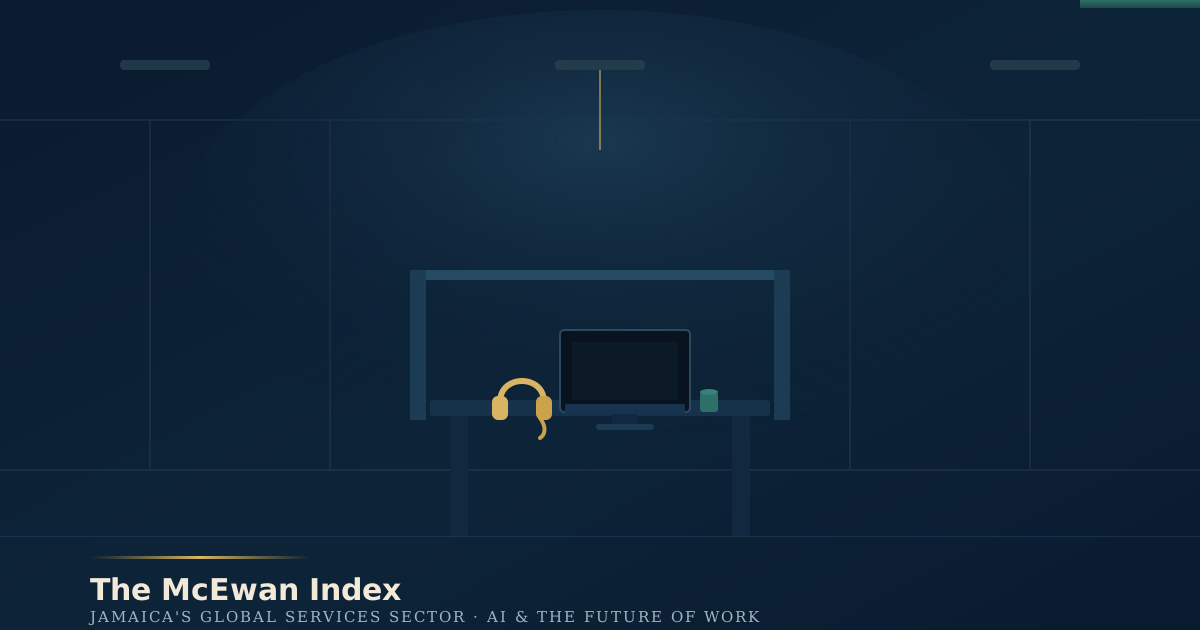
The headset sits on the desk exactly where its last owner left it. The monitor is dark. A lanyard hangs from a cubicle wall that once separated one agent's workstation from the next, in a Montego Bay Free Zone building that used to fill three shifts a day. Somewhere in this room, a supervisor's whiteboard still carries last quarter's call-handling targets, numbers nobody has bothered to erase because nobody has bothered to walk past them in weeks.
This is not one lost job. It is the physical residue of a US$220 million question that Jamaica now has to answer, in public, with the world watching.
For a decade and a half, business process outsourcing was the industry Jamaica pointed to when it needed proof that the country could build something other than bauxite, sugar and sun. It absorbed school leavers from Portmore, single mothers from Spanish Town, university graduates who could not find work in their own field, and it gave them a payslip, a uniform, and a first taste of corporate structure. It became, in the space of a decade, Jamaica's second-largest employer.
That story is now under strain. According to the Government of Jamaica's own annual report on Form 18-K, filed with the United States Securities and Exchange Commission for the fiscal year ended March 2026, the global digital services sector spent an estimated US$780 million in the local economy, down from roughly US$1 billion the year before. Employment fell to approximately 50,000 from 62,000 two years earlier. The number of operating companies dropped from more than 90 to about 70.
The Global Services Association of Jamaica tells a starker version of the same story. Its own president, Yoni Epstein, places employment at around 40,000, a level he says has now held for two consecutive years, down from a peak of 60,000 to 65,000 workers in 2023 and 2024. Outgoing GSAJ president Wayne Sinclair put the decline at roughly a third of the sector's workforce in two years.
Two governments, one industry, two very different head counts. That discrepancy is itself a signal, and this article treats it as one.
The question this piece sets out to answer is not whether the numbers are bad. They are. The question is whether Jamaica is living through a cyclical correction, the kind every export industry experiences when a hurricane, a currency swing or a competitor's incentive package knocks it off course for a year or two, or whether it is witnessing the early stage of a structural transformation, one being driven simultaneously by artificial intelligence, geopolitics, rising costs, and a fundamental change in what multinational buyers of outsourced labour actually want to buy.
The answer, as this piece will argue, is that both are true at once, and that the distinction between them matters enormously for policy.
The numbers behind the headlines
Start with what the US$220 million actually represents. It is not export revenue. It is local spending, the wages, lease payments, utility bills and operating costs that BPO and knowledge process outsourcing firms pour into the Jamaican economy regardless of where their invoices are sent. Export earnings are a different, and generally larger, figure.
Even at US$780 million, that local spending outweighs what Jamaica earned in 2025 from bauxite and alumina exports, the industry that anchored the economy for most of the twentieth century. It is equivalent to close to half of the country's total merchandise exports. A sector that most Jamaicans experience as a call centre job is, in balance-of-payments terms, doing heavier lifting than the mining sector that built Discovery Bay and Ewarton.
The jobs numbers deserve equal scrutiny. The government's 18-K filing has consistently run higher than the GSAJ's own census, and the gap has been widening rather than narrowing. In March 2025, government data reported roughly 55,000 jobs against the GSAJ's 40,000, a difference of 15,000. A year later, the government's figure had fallen to 50,000 against the same GSAJ estimate of 40,000, narrowing the gap to 10,000, even as both sides agree the underlying trend is down.
The discrepancy most likely reflects different survey windows, different definitions of who counts as a global services worker, and different treatment of shared services and captive operations that large multinationals run in-house rather than through third-party BPO vendors. It matters because policy built on the wrong number risks either under-reacting to a crisis or over-reacting to a rounding error. A working group that includes the GSAJ, the Port Authority of Jamaica, JAMPRO and the Jamaica Special Economic Zone Authority has been tasked with closing that gap alongside its growth mandate, and reconciling the count should be treated as job number one, not an afterthought.
The employment target itself tells its own story of a strategy overtaken by events. Government had aimed for 70,400 jobs by March 2025. It missed by 15,400. By March 2026, the shortfall against that same target had widened to 20,400. This was not a plan that failed on arrival. It was a plan that was on pace, and then was not.
The Development Bank of Jamaica's own portfolio adds a further layer of ambiguity. Since 2012, the DBJ has disbursed US$90.01 million across 20 BPO ventures with combined capacity for 27,513 jobs. The government's 2025 annual report said all 20 projects were leased, occupied, and had produced 22,598 jobs. The 2026 report revised that to only 19 leased and occupied, with the twentieth completed but still without an operator, at peak historical employment of the same 22,598 figure. Neither report explains the change. For an industry that depends on investor confidence, unexplained revisions to occupancy data are their own small tax on credibility.
Is artificial intelligence actually taking the jobs
This is the question every worker in every Free Zone building in Portmore, Montego Bay and Kingston is asking, and the honest answer is more layered than either side of the current debate wants to admit.
Industry leadership in Jamaica has been unusually direct in rejecting an AI-driven narrative. Epstein has attributed the sector's contraction primarily to weak productivity relative to competing destinations, labour shortages linked to Jamaica's own near full-employment conditions, and the disruption caused by Hurricane Melissa, arguing that artificial intelligence is not yet the deciding factor and may in fact become a productivity tool that helps Jamaican operators compete rather than a replacement for Jamaican workers.
There is real evidence to support caution about overstating AI's role in Jamaica specifically. But the regional and global data suggest that dismissing AI's role entirely would be equally wrong, and the picture that is emerging from the world's largest BPO market, the Philippines, is instructive precisely because it shows a more accurate middle position.
The Philippines' industry association, IBPAP, has quietly cut its own long-range revenue targets this year, citing artificial intelligence adoption, shifting buyer behaviour and intensifying global competition as three simultaneous forces, the same three forces cited in Jamaica's own government filing. The International Monetary Fund estimates that roughly three per cent of Philippine BPO workers, translating to tens of thousands of people, occupy roles with what economists call low AI complementarity, meaning generative AI can perform the task with minimal human oversight rather than simply assisting a human doing it. Other IMF-adjacent analysis has put the vulnerable share of the entire Philippine workforce as high as a third, concentrated in the outsourcing sector specifically.
The distinction between complementarity and substitution is the single most useful analytical tool available for understanding what is happening to BPO jobs everywhere, including Jamaica. Work that is scripted, repetitive, and low in ambiguity, a customer asking to check an account balance, a simple password reset, first-tier order status inquiries, is precisely the work that large language models and voice AI systems now perform at a cost per interaction that undercuts even Jamaica's relatively low wage floor. Work that requires judgment under ambiguity, empathy in an emotionally charged call, escalation handling, regulatory interpretation, or navigating a client relationship, is work that AI currently assists rather than replaces.
The World Economic Forum's Future of Jobs research puts a number on the churn this creates globally. It projects that automation and AI could eliminate roughly 92 million jobs by 2030 while creating around 170 million new ones, a net gain, but one that depends entirely on whether the workers being displaced are the same workers gaining access to the new roles, which historically they are not. A separate WEF estimate suggests close to a third of the tasks performed by entry-level workers are now ripe for automation, and entry-level, first-tier customer service is exactly where Jamaica's BPO sector has concentrated its employment.
So which jobs disappear first? Tier-one voice support for high-volume, low-complexity queries. Basic data entry. Simple back-office transaction processing. Scripted outbound sales calls. Which jobs survive and even grow? Complex technical support, complaints escalation, healthcare and financial services support requiring regulatory literacy, and any role where a client explicitly pays a premium for a human being to take responsibility for an outcome. Which new jobs are emerging? AI quality assurance and model evaluation, prompt and workflow design, automation oversight, data annotation, and a growing category the Philippines has begun formally training for: the human supervisor of an AI agent fleet, a role that requires the soft skills of a call centre veteran layered onto a new technical vocabulary.
Jamaica's own account, that Hurricane Melissa, cost competitiveness and productivity gaps explain most of the recent job losses, is very likely correct for 2025 and 2026 specifically. But it would be a mistake to read that as evidence the country has time before AI becomes the dominant factor. The Philippine experience suggests the AI effect arrives gradually and then compounds quickly, and that industries which wait for unambiguous proof before adapting tend to adapt from a position of crisis rather than strength.
From BPO to KPO: the only durable answer
The working group formed in response to the sector's decline has set a specific and genuinely ambitious target: shifting the industry's mix of business process outsourcing to knowledge process outsourcing work from roughly 80:20 to 60:40.
The distinction matters more than the acronyms suggest. BPO is largely process execution, running someone else's defined workflow at scale, and it competes primarily on labour cost. Information technology outsourcing, or ITO, covers technical services such as software maintenance, help desk and infrastructure support, and sits a rung higher on the value ladder. Knowledge process outsourcing, KPO, involves domain expertise, judgment and analysis, data science, actuarial work, legal process support, equity research, medical coding, financial reporting, and it competes on skill and quality rather than cost per hour. Shared services centres and the newer category of Global Capability Centres, in which a multinational builds and owns its own offshore operation rather than contracting a third-party vendor, sit somewhere across this spectrum but tend to cluster toward higher-value, longer-tenure work precisely because the parent company has made a capital commitment rather than a short-term vendor contract.
The productivity argument for the shift is straightforward economics. A KPO analyst reviewing insurance claims or reconciling financial statements generates more value added per hour than a tier-one voice agent, commands a higher wage that is still competitive by international standards, and is considerably harder for a general-purpose AI model to fully replace, because the work involves professional judgment, regulatory accountability and client-specific context that current systems handle poorly without a human in the loop. A country that moves its mix toward KPO is not simply chasing better jobs. It is building a more AI-resilient economic base, because resilience against automation and value added per worker are, in this sector, close to the same variable.
Jamaica has some of the ingredients already in place. HEART/NSTA Trust, the United Kingdom's Trade Partnerships Programme and the Inter-American Development Bank are already engaged in preparing GDS firms and workers for this transition. JAMPRO has been actively courting international KPO operators and working with local universities on training partnerships in KPO and ITO. What Jamaica does not yet have is scale, a critical mass of firms and graduates large enough to be visible on a multinational's shortlist the way Colombia, with a BPO workforce exceeding 790,000 and services exports of nearly US$3 billion, or the Philippines, with close to two million workers and export revenue above US$40 billion, already are.
Why companies are actually leaving
No single cause explains the sector's contraction, and any policy response built on a single cause will fail. At least six distinct forces are operating simultaneously.
Automation is real but, per the analysis above, is likely a secondary rather than primary driver in Jamaica's specific 2025 and 2026 numbers, more a rising tide than the wave that has already hit. Reshoring and nearshoring are more immediate. Many multinational clients are relocating work not to Asia but closer to home, to Latin American destinations offering similar or better cost structures with tighter time-zone alignment to US operations, a trend that Colombia, Costa Rica and the Dominican Republic have all captured share from.
Jamaica's own cost base has moved in the wrong direction relative to competitors. Rising wages, driven partly by an economy approaching full employment, a point Epstein himself has made, combine with inflation and elevated energy costs to erode what was once Jamaica's clearest advantage: being cheap. Electricity reliability and internet quality, already a competitiveness concern before October 2025, became acute afterward.
Hurricane Melissa is not a footnote to this story. It is one of its central chapters. The storm made landfall as a Category 5 hurricane on October 28, 2025, the strongest ever recorded in Jamaica, and the World Bank and Inter-American Development Bank estimated physical damage at US$8.8 billion, equivalent to 41 per cent of the country's 2024 GDP. The government's own SEC filing is explicit that the storm disrupted electricity and telecommunications networks across the island, directly constraining BPO firms' ability to meet the service-level agreements that international clients contractually require, while displaced workers and damaged transport networks further reduced productive capacity. For an industry that sells uptime and reliability as its core product, a storm that knocks out power and connectivity for weeks is close to a worst-case scenario, and its effects will likely show up in client retention data for another year or two even as physical reconstruction proceeds.
Layer onto this a genuine shift in what global buyers of outsourced services now expect. Clients increasingly want vendors who can demonstrate their own AI adoption roadmap, cybersecurity certification, and a documented data protection regime, not simply a large pool of English-speaking labour at a competitive rate. A vendor selling only headcount is selling into a shrinking market. A vendor selling AI-augmented, higher-skill service delivery is selling into a growing one.
Jamaica's competitive position, honestly assessed
Measured against the destinations it competes with most directly, Jamaica's position is mixed rather than uniformly weak, and understanding exactly where the gaps sit is more useful than a generic verdict.
On English proficiency and cultural affinity with the North American market, Jamaica remains genuinely strong, arguably stronger than several Latin American competitors whose agents speak excellent Spanish but accented English. On labour cost, Jamaica has lost ground to Colombia and to parts of Central America as local wages have risen faster than productivity, a point Epstein has made explicitly in blaming competitiveness gaps for recent losses. On infrastructure resilience, specifically electricity and telecommunications continuity, Jamaica now carries a visible scar from Hurricane Melissa that Costa Rica, with its more diversified and less storm-exposed grid, and the Dominican Republic, with its deep bench of Free Zone infrastructure, do not carry to the same degree.
On the ease of doing business and investment incentives, Jamaica has real strengths through JAMPRO, the Special Economic Zone regime and DBJ financing, but scale is the limiting factor. Costa Rica has built a nearshoring reputation strong enough to attract life sciences and technology multinationals specifically because of political stability, workforce depth and years of consistent positioning, factors that JLL and other global site-selection advisors cite repeatedly. The Dominican Republic leads the region in the sheer number of Free Zone companies. Colombia has more than doubled its share of the region's modern services exports in recent years. India remains, at a different order of magnitude entirely, the world's dominant KPO and ITO hub, with a talent pipeline Jamaica cannot match in scale but can, in specific niches, compete with on cost and time-zone alignment for the US market.
The honest comparative verdict is that Jamaica is not losing on any single dimension so much as it is being outpaced on the combination of all of them at once, while its most reliable historical advantage, low cost, is the one eroding fastest.
The human cost behind the balance sheet
Behind every one of the roughly 12,000 jobs the sector has shed over two years sits a household budget that has to be rebuilt. Free Zone jobs in Montego Bay, Portmore and other BPO hubs disproportionately employed women and young people, often as a first formal job after secondary school or as a bridge income while pursuing further study, and often in parishes with comparatively few alternative formal employers.
A lost BPO income does not simply reduce one person's spending. It ripples into mortgage and rent payments in communities built partly on the expectation of steady shift-work income, into student loan repayment for graduates who took the job as a stopgap and stayed for the paycheque, and into household consumption more broadly in towns where the call centre was, for a decade, the largest single employer within commuting distance. Career uncertainty of this kind carries a psychological weight that does not show up in a GDP release, and it deserves acknowledgment even in an analytical piece built around economic data, because the data exists to describe exactly this kind of lived disruption, not to replace it.
What investors actually evaluate now
Multinational firms deciding where to place their next global services operation are no longer running the calculation Jamaica won in 2012, when cheap, reliable English-speaking labour was close to the entire pitch. Today's evaluation runs through political stability, fibre connectivity and grid resilience, the depth of a skilled labour pipeline specifically in data and technical roles, the durability of tax incentives, regulatory certainty, formal data protection frameworks that satisfy clients in regulated industries such as finance and healthcare, demonstrable cybersecurity posture, environmental and social governance commitments that are increasingly a procurement requirement rather than a nicety, access to renewable energy, and evidence of a functioning local innovation ecosystem that suggests the location can grow with the client rather than simply execute today's contract.
Jamaica meets some of these criteria well and others only partially. The most urgent gaps, based on the analysis above, sit in energy and telecommunications resilience following Hurricane Melissa, and in the depth of a technical and data-literate labour pipeline large enough to make KPO expansion credible at scale rather than as a handful of pilot projects.
Jamaica's opportunity, if the pivot is real
None of this argues that Jamaica's global services sector is finished. It argues that the version of the sector Jamaica built between 2012 and 2023, a scale-first, cost-competitive voice and data-entry model, has reached the end of its useful life, and that the country now has a genuine opportunity to build something more durable in its place.
Jamaica's proximity to the United States, English fluency, existing Free Zone infrastructure and a decade and a half of operational experience running global service delivery give it a real foundation to compete for higher-value work in financial operations, data science, cybersecurity services, software development, digital consulting, health technology support and fintech back-office functions, several of which are already growing regional categories that Costa Rica and Colombia have captured disproportionate shares of. A realistic ambition is not to out-scale the Philippines or India. It is to become the Caribbean's most credible mid-sized hub for AI-augmented knowledge services, anchored in financial services and healthcare-adjacent KPO work where regulatory literacy and an English-language legal tradition are genuine advantages.
Policy recommendations
For government, the most urgent task is closing the employment data gap between the GSAJ census and the official 18-K filing, because policy calibrated on the wrong baseline will either under-fund or mis-target the response. Alongside that, energy grid resilience and telecommunications redundancy need to be treated as global services competitiveness infrastructure, not simply as post-hurricane recovery spending, since international clients evaluate uptime as a contractual requirement. The 60:40 BPO-to-KPO target needs a funded, time-bound implementation plan rather than a stated aspiration, and the working group's mandate should be judged publicly against measurable milestones.
For universities and training institutions, curricula need to move faster on data science, applied AI operations, cybersecurity, cloud infrastructure and business analytics, in direct partnership with JAMPRO's KPO recruitment efforts, so that Jamaica can show prospective investors a visible graduate pipeline rather than a promise of one.
For businesses already operating in the sector, the imperative is to adopt AI as a productivity tool before a client forces the issue, since firms that can demonstrate their own automation roadmap are increasingly the firms winning new contracts, and to invest in reskilling existing staff into quality assurance, escalation and AI-oversight roles rather than treating displacement as an inevitability to manage rather than a transition to shape.
For workers, the single most protective strategy available is diversifying beyond scripted, single-task skills toward the judgment-heavy, client-facing and technically literate work that both the WEF and IMF research identify as far more resistant to displacement, including professional certifications in data, cybersecurity or specialised process areas that raise a worker's position on the BPO-to-KPO ladder regardless of which specific employer they work for.
The verdict
Is this a temporary contraction or a structural transformation. The honest answer, after weighing the government's own account, industry leadership's account, and the regional and global evidence, is that it is both, unfolding on two different timelines at once.
The immediate 2025 to 2026 decline is substantially cyclical, driven by a historic hurricane, a tight domestic labour market and a specific competitiveness gap against faster-moving Latin American rivals. That part of the story could plausibly reverse as reconstruction proceeds and the working group's initiatives take hold.
But the underlying direction of travel, toward AI-augmented service delivery, toward KPO over BPO, toward buyers who evaluate a vendor's technology roadmap as closely as its labour cost, is structural, global, and not reversible. The Philippines, the world's largest and most successful outsourcing economy, is already cutting its own long-range targets in response to exactly these forces, from a position of far greater scale than Jamaica's.
The US$220 million question, then, is not really about the money at all. It is about whether Jamaica treats this moment as a downturn to be waited out, or as the narrow window in which a fifteen-year-old industry either climbs the value chain or gets climbed past.
Editorial and publication package
SEO headline (under 60 characters): Jamaica's BPO Slide: Cycle or Structural Shift?
Subtitle: A US$220 million drop in local spending forces Jamaica to confront whether AI, not just Hurricane Melissa, is reshaping its global services sector for good.
SEO title: Jamaica BPO Slowdown 2026: AI, Jobs and the KPO Pivot Explained
Meta description (150–160 characters): Jamaica's BPO sector lost US$220 million and 5,000 jobs in a year. An in-depth look at AI, Hurricane Melissa, and the shift to knowledge process outsourcing.
Focus keyword: Jamaica BPO industry decline
Related keywords: Jamaica global services sector, KPO Jamaica, BPO AI job losses, Global Services Association of Jamaica, Jamaica nearshoring competitiveness
URL slug: /jamaica-bpo-slide-ai-kpo-future-of-work
Social media excerpt: Jamaica's outsourcing sector just lost US$220 million in local spending and thousands of jobs in a year. Is Hurricane Melissa to blame, or is AI quietly rewriting the industry's future? A full breakdown of the numbers, the competition, and the path to KPO.
Pull quotes:
- "A sector most Jamaicans experience as a call centre job is, in balance-of-payments terms, doing heavier lifting than the mining industry that built Discovery Bay."
- "The US$220 million question is not really about the money. It is about whether Jamaica climbs the value chain or gets climbed past."
- "A vendor selling only headcount is selling into a shrinking market."
Image recommendations:
- A dimly lit, empty BPO workstation with a headset resting on the desk (AI-generated or illustrative, not a real facility photo).
- A split comparative graphic showing Jamaica, Philippines, Colombia and Costa Rica outsourcing employment and export figures side by side.
- A line chart tracking Jamaica's GDS employment and local spending from 2020 to 2026.
- A stylised diagram of the BPO-to-KPO value ladder (BPO, ITO, KPO, Global Capability Centres).
Alt text examples:
- "Empty call centre workstation with unused headset symbolising Jamaica's BPO sector contraction."
- "Chart comparing BPO and KPO employment trends in Jamaica, the Philippines, Colombia and Costa Rica, 2020 to 2026."
Recommended data visualisations:
- Jamaica GDS employment trend, 2020 to 2026 (line chart)
- Local spending versus export earnings, GDS sector (bar chart)
- Jamaica versus competitor destinations: labour cost, English proficiency, infrastructure reliability (radar chart)
- BPO to KPO value-added comparison (bar chart)
- WEF/IMF global jobs displaced versus jobs created by AI, 2025-2030 (stacked bar chart)
- Skills demand forecast: declining versus growing GDS job categories (horizontal bar chart)
Internal linking suggestions: Jamaica's energy crisis and grid resilience coverage; Jamaica's Global Peace Index and investment climate piece; HEART/NSTA Trust human capital analysis; Jamaica's Third Country National and labour market series.
External authoritative sources to link: Government of Jamaica Form 18-K annual report (US SEC); Global Services Association of Jamaica; World Bank/IDB Hurricane Melissa damage assessment; IMF working paper on AI and the Philippine labour market; World Economic Forum Future of Jobs Report; PIOJ quarterly economic briefing.
Frequently Asked Questions
Is artificial intelligence the main reason Jamaica's BPO industry is shrinking? Not yet, according to industry leadership, who attribute most of the recent decline to Hurricane Melissa, rising costs and productivity gaps against competitors. Regional evidence from the Philippines suggests AI's impact is growing quickly and will likely become a larger factor within a few years.
How many jobs has Jamaica's BPO sector actually lost? Government data shows employment falling to about 50,000 in March 2026 from 62,000 two years earlier. The Global Services Association of Jamaica puts current employment closer to 40,000, a gap that reflects differing survey methods and coverage.
What is the difference between BPO and KPO? BPO involves executing routine, process-driven tasks such as customer service calls, competing mainly on labour cost. KPO involves analytical and judgment-based work such as data analysis, financial reporting or legal process support, competing on skill and expertise rather than price alone.
Why did Hurricane Melissa affect the BPO sector specifically? The October 2025 storm caused widespread power and telecommunications outages, directly undermining BPO firms' ability to meet the service-level agreements international clients require, on top of an estimated US$8.8 billion in total physical damage nationally.
Can Jamaica compete with the Philippines or India in global services? Not at the same scale. Jamaica's realistic path is toward becoming a smaller, higher-value regional hub focused on AI-augmented knowledge services, particularly in financial and healthcare-adjacent KPO work, rather than competing on volume.