What Jamaica's Work Permit Numbers Really Measure

Behind the annual list of nationalities lies a more revealing story about shortages, investment and the limits of the domestic skills pipeline
By:Janiel McEwan, Economist and Researcher
Every year the same headline appears with the predictability of a tide table. Chinese nationals top the list of foreign workers granted permits to work in Jamaica, and every year the figure invites the same shallow reading: a story about which country is "taking" the most permits. That framing has always missed the point, and it misses it again in the 2025 numbers released in the Economic and Social Survey Jamaica.
The more useful question is not who received the permits. It is what the demand for foreign labour, renewed year after year in broadly the same sectors and the same occupations, tells us about the Jamaican economy that domestic statistics alone cannot. A work permit is issued only when an employer has already concluded, and a government official has already agreed, that no suitably qualified Jamaican was available to fill a specific role. Read collectively, thousands of such approvals become a map of exactly where the domestic labour market is falling short, and of where capital is flowing in fast enough that the workforce cannot keep pace.
That is the real subject of this piece. What do these work permit statistics really tell us about the strengths and weaknesses of Jamaica's labour market?
The 2025 picture
According to the Planning Institute of Jamaica's 2025 Economic and Social Survey, the Ministry of Labour and Social Security received 5,701 work permit applications during the year, an increase of 0.9 per cent over 2024. The composition of that growth is instructive. Renewal applications fell by 3.5 per cent to 2,972, while new applications rose by 6.1 per cent to 2,729. In other words, the growth in demand for foreign labour last year came almost entirely from new hires rather than from extensions of existing arrangements, a signal that fresh projects and fresh investment, not merely the rollover of long-standing postings, drove the increase.
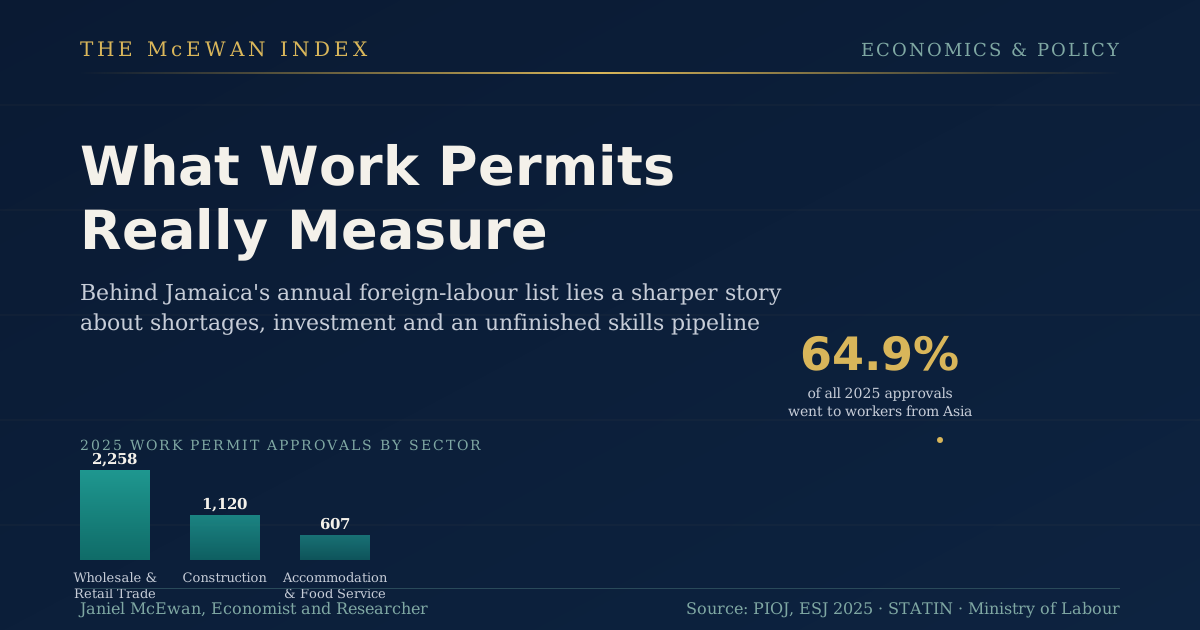
Of the applications received, 96.6 per cent, or 5,509, were approved. Roughly four in five of those approvals, 79.3 per cent, went to men, a pattern consistent with the industries in which foreign labour is concentrated. Nationals of China again received the largest single share, with 2,441 permits. India followed with 882, and Cuba with 307. Asia as a region accounted for 64.9 per cent of total approvals, with Latin America contributing 13.5 per cent.
Sectorally, approvals clustered in wholesale and retail trade and repair of motor vehicles and motorcycles, which together accounted for 2,258 permits, followed by construction with 1,120 and accommodation and food service activities with 607. These three groupings alone account for the overwhelming majority of all work permits issued in Jamaica in a typical year, and 2025 was no exception.
The legal architecture behind all of this has barely changed in six decades. Under the Foreign Nationals and Commonwealth Citizens (Employment) Act of 1964, any non-Jamaican wishing to work on the island must first secure ministerial approval, generally on the basis that the position could not reasonably be filled by a Jamaican worker. It is a labour market test, applied case by case, sector by sector, and it has produced a fairly stable pattern of approvals for a generation. What has changed is the scale and composition of the investment sitting behind those applications, and that is where the analysis has to begin.
Permits as economic indicators, not immigration trivia
Treating work permit data as an immigration curiosity understates its analytical value considerably. Properly read, the numbers function as a proxy for at least five distinct signals about the Jamaican economy.
The first is labour shortage. A permit is only issued after a determination that the domestic pool cannot supply the skill in question. Persistent, multi-year demand for the same categories of worker, welders, engineers, project supervisors, is not noise. It is a structural shortage hiding in plain sight.
The second is investment intensity. Construction's consistent second-place ranking among approving sectors tracks closely with the pace of infrastructure and property development on the island. When permit numbers in that sector rise, it is frequently a leading indicator of construction activity that has not yet shown up fully in GDP figures.
The third is business confidence. Foreign firms do not commit specialist personnel, at real cost and administrative friction, to markets they expect to contract. A steady flow of new work permit applications, as distinct from renewals, is itself a vote of confidence in the medium-term trajectory of the Jamaican economy.
The fourth is the specific character of skills gaps. Occupational data on approvals, when read against HEART/NSTA Trust enrolment figures and university graduate output, exposes exactly where Jamaica's education and training system is not producing enough people fast enough, whether in technical trades, engineering disciplines or specialised hospitality management.
The fifth is the broader story of economic transformation. As Jamaica's economy diversifies from tourism-led growth toward logistics, business process outsourcing, renewable energy and infrastructure, the composition of work permits shifts too, offering an early read on where the next phase of structural change is heading before national accounts data confirms it.
Why China leads the list, year after year
The consistency of Chinese nationals topping Jamaica's work permit rolls is not coincidental, and it does not require a political explanation. It is a direct function of where Chinese capital has gone in Jamaica over the past two decades.
Chinese policy banks, principally the Export-Import Bank of China and the China Development Bank, financed roughly two billion United States dollars in loans to the Jamaican government between 2005 and 2022, much of it directed at road infrastructure. The North-South Highway, linking Ochos Rios to Kingston and completed in 2016, was financed substantially through Chinese credit and built by the China Harbour Engineering Company, which has since led several further infrastructure projects on the island. Chinese foreign direct investment stock in Jamaica grew from roughly 40 million dollars in 2011 to more than 800 million dollars by the end of 2016, and it has continued to expand since, concentrated overwhelmingly in construction and infrastructure.
Large infrastructure and construction contracts of this kind typically arrive with their own project management structures, specialised equipment operators and technical supervisors, particularly in the early phases of a project when local subcontracting relationships are still being established. That is a familiar pattern in infrastructure financing globally, not a Jamaica-specific anomaly, and it explains why construction and related trades dominate the occupational breakdown of Chinese work permits far more convincingly than any account resting on national stereotype or preference.
None of this means the pattern is beyond scrutiny. It is entirely reasonable to ask whether contract terms attached to Chinese-financed infrastructure could do more to mandate the transfer of skills and the phased localisation of the workforce as projects mature. That is a policy question, not an accusation, and it belongs squarely in the recommendations that follow.
The shortages the data confirms
Look past the nationality breakdown and the occupational pattern becomes unmistakable. Jamaica's economy continues to import expertise in structural and civil engineering, project management, welding and other skilled trades, electrical and refrigeration technicians, ICT specialists, and senior hospitality management. These are not exotic specialisations. They are precisely the mid-to-senior technical roles that a maturing, investment-hungry economy needs in depth, and precisely where Jamaica's training pipeline has struggled to keep pace with demand.
The consequences show up in productivity statistics long before they show up in political debate. When a construction firm cannot find a Jamaican structural engineer with the right certification, the project either slows, costs more, or is staffed from abroad. Multiply that friction across dozens of concurrent infrastructure and tourism developments and the aggregate drag on productivity becomes significant, even though it rarely appears as a single identifiable line item in national accounts.
This is happening against the backdrop of one of the tightest labour markets in Jamaica's modern history. The Statistical Institute of Jamaica recorded an unemployment rate of 3.3 per cent through much of 2025, a record low, with the labour force reaching 1,490,300 persons and total employment climbing to 1,441,100 by mid-year. Youth unemployment, while still elevated relative to the overall rate at around 10 to 11 per cent, has also been falling. A labour market this tight has less slack to absorb specialised demand internally, which only sharpens the case for imported expertise in the near term, even as it strengthens the case for accelerated domestic skills investment over the medium term.
Foreign labour and local employment: a false binary
Public anxiety about foreign workers displacing Jamaicans is understandable, but the data does not support a simple substitution story. With unemployment at record lows and vacancies persisting in specific technical categories, the more accurate description of most work permit cases is complementary employment rather than displacement. A Chinese project engineer supervising a highway contract, or an Indian technician commissioning specialised manufacturing equipment, is generally filling a role for which no unemployed Jamaican with the matching qualification currently exists, not one that a Jamaican worker was denied.
That distinction matters, but it should not be used to dismiss the underlying concern entirely. Where genuine misconceptions do real damage is in conflating shortage-driven permits, largely concentrated in specialised technical and supervisory roles, with the far smaller and more legitimately contestable set of cases where a foreign hire may be substituting for available local capacity, whether through employer preference, cost arbitrage or simple inertia in recruitment practice. The 1964 Act's labour market test exists precisely to police that boundary, and its rigorous, transparent enforcement matters more to public confidence than any change to the headline permit numbers.
The more productive framing, and the one this publication has argued for consistently in its work on HEART/NSTA Trust and technical education, is to treat every recurring category of imported skill as a standing instruction to the domestic training system. If welders, electricians and project managers appear on the shortage list year after year, that is not evidence that Jamaicans cannot do these jobs. It is evidence that too few are being trained to do them at the pace the economy now requires.
Education, training and the alignment problem
Jamaica's tertiary and vocational architecture, anchored by HEART/NSTA Trust, the University of Technology, the University of the West Indies and a growing network of community colleges, has expanded considerably in scope over the past decade. The persistent question is not capacity in the abstract but alignment: whether enrolment patterns and curriculum design are keeping pace with where investment and infrastructure spending are actually concentrated.
Apprenticeship models, in which trainees rotate through paid, structured placements with construction firms, manufacturers and hospitality groups, remain underdeveloped relative to their potential. Countries that have successfully reduced dependence on imported technical labour, Singapore prominent among them, have generally done so not by restricting foreign worker inflows outright but by pairing them with aggressive, employer-linked apprenticeship and certification pipelines that shrink the shortage from the supply side rather than the demand side. Jamaica has the institutional building blocks for something similar. What has been missing is the systematic linkage between labour market forecasting, several years out, and the specific technical programmes HEART and its partner institutions prioritise for expansion.
Foreign direct investment and the permit relationship
Work permits rarely arrive independent of capital. According to UNCTAD's World Investment Report 2025, FDI inflows to Jamaica totalled 156 million United States dollars in 2024, down sharply from 377 million dollars the year before, though the accumulated FDI stock stood at roughly 18.9 billion dollars, close to 94 per cent of GDP, making Jamaica among the largest FDI recipients relative to the size of its economy in the small island developing world. Tourism has absorbed the largest share of that stock historically, followed by information and communication technology, with construction, minerals and agro-processing also drawing meaningful capital.
Every dollar of that investment carries an implicit expectation. Investors want confidence that specialised personnel can be deployed where local capacity is still developing, that management expertise and technology can move with the capital rather than being held up by permitting friction, and that the arrangement is temporary rather than permanent. Handled well, work permits become a channel for exactly the knowledge transfer, supply chain deepening and productivity spillovers that make foreign investment valuable in the first place, rather than merely a headcount of imported labour. Handled poorly, either through excessive restriction that deters investment or excessive laxity that allows permits to substitute indefinitely for local hiring and training commitments, the same instrument can undermine the very development objectives it is meant to serve. Getting that balance right, rather than debating nationality totals, is the substantive policy challenge.
Lessons from elsewhere
Singapore offers the most instructive comparison, not because Jamaica should replicate its model wholesale but because it demonstrates how a labour-scarce economy can manage foreign worker dependence through price signals rather than blunt caps. Singapore's Ministry of Manpower charges employers a monthly foreign worker levy for every work permit holder, with the rate calibrated to the worker's skill level and the employer's proximity to a sector-specific dependency ratio ceiling. Employers who bring in higher-skilled workers, or who invest in upgrading existing staff, pay lower levies, which creates a continuous financial incentive to deepen local capability rather than simply renew the same low-skill permits indefinitely.
Canada's Labour Market Impact Assessment process performs a broadly similar function to Jamaica's 1964 Act, requiring employers to demonstrate that no Canadian worker is available before a temporary foreign worker permit is issued, but it pairs that test with published, occupation-specific wage floors and regularly updated shortage lists that give employers, and policymakers, far greater forward visibility than an annual retrospective survey provides. Barbados and Trinidad and Tobago, working within a labour market of comparable scale and CARICOM's freedom of movement provisions for skilled nationals, have each experimented with faster processing for identified priority sectors, energy services in Trinidad's case, financial and business services in Barbados's, an approach that concentrates administrative attention on the categories most likely to unlock investment rather than treating every application identically.
The common thread across these systems is not restriction. It is information and calibration: knowing, well in advance, where shortages are emerging, and building policy instruments, whether levies, wage floors or priority processing, that respond to that knowledge rather than reacting to it a year after the fact.
What policy should do next
Several reforms would sharpen Jamaica's ability to convert work permit data from an annual curiosity into a genuine planning tool. Improved labour market forecasting, produced jointly by the Planning Institute, STATIN and the Ministry of Labour, would allow shortage categories to be identified three to five years ahead of the investment cycle that creates them, rather than confirmed only after the permits have already been approved. Stronger workforce planning within HEART/NSTA Trust, explicitly tied to the sectors absorbing the largest volumes of foreign labour, construction trades, engineering technicians and ICT specialisation among them, would let training capacity expand ahead of demand rather than behind it.
Targeted technical education, delivered in partnership with the firms actually sponsoring work permits, would shorten the distance between classroom certification and site-ready competence. Expanded, paid apprenticeship placements, embedded within major infrastructure and tourism projects from the outset rather than added as an afterthought, would give Jamaican workers direct exposure to the technical standards foreign specialists are currently meeting. Formal succession planning requirements, written into major investment agreements, could obligate sponsoring employers to identify and train a Jamaican counterpart for each specialised foreign hire over a defined period, converting today's imported skill into tomorrow's domestic capability.
Explicit technology transfer requirements attached to large infrastructure financing, of the kind already common in comparable middle-income economies, would help ensure that Chinese, Indian and other foreign-financed projects leave behind more than completed roads and buildings. Stronger local hiring incentives, calibrated rather than punitive, could reward employers who demonstrably reduce their reliance on renewed permits over time. Periodic, structured labour market reviews, rather than an annual statistical release read once and set aside, would keep policymakers focused on trend rather than snapshot. And continued, transparent publication of work permit statistics, ideally disaggregated further by occupation and by whether an application was new or a renewal, would let researchers, employers and the public track progress against every one of these goals rather than debating nationality totals each July.
None of these recommendations require restricting investment or making Jamaica a harder place to do business. Each is designed to do the opposite: to make foreign capital more productive precisely by ensuring it leaves a deeper skills base behind.
The real question
The nationality breakdown will change little from one year to the next, and readers tempted to fixate on whether China or India tops next year's list will have missed what the data has been saying all along. The real policy question is not whether Jamaica should employ foreign workers. It is whether the country is developing enough skilled Jamaicans to ensure that, over time, economic growth is increasingly powered by local talent while remaining attractive to global investment.
That is a test Jamaica can pass, but only if work permit statistics are read for what they are: not an annual immigration tally, but one of the clearest available measures of the country's economic competitiveness. Every renewed permit in a shortage occupation is a small, quantifiable reminder of a gap between where the economy is investing and where the workforce is prepared to meet it. Closing that gap, sector by sector and cohort by cohort, is the work of educators, employers and policymakers alike, and it will matter far more to Jamaica's next decade of growth than any single year's list of nationalities ever could.
Janiel McEwan, Economist and Researcher