Hurting Jamaica: The Beach Debate We Keep Getting Wrong

Free beaches, paid beaches and public responsibility: what the evidence actually shows
Janiel McEwan, Economist and Researcher
Jamaica is arguing about beaches as though the country has only two choices. Either every Jamaican gets free access to every beach, or private investment and tourism get to decide who passes through the gate. Tourism Minister Edmund Bartlett gave that binary its latest airing on August 8, 2026, when he told a food festival crowd in Falmouth that claims of Jamaicans being "locked off" from their coastline were untrue and were hurting the country's reputation abroad. Activists, in turn, have spent two years telling international media that less than one per cent of Jamaica's coastline is freely accessible to its own people.
Both claims cannot be sloganeering. One of them, or parts of both, must be checked against the law, the data and the record. That is the purpose of this piece. Not to referee a shouting match, but to work out what "public beach" actually means in Jamaica, who controls it, who pays for it, and what a fair system would look like if the country decided to build one on evidence rather than outrage.
The short version of where this investigation lands: Jamaica does not have a beach-access crisis reducible to a single percentage, in either direction. It has an old law that never resolved the tension it was built to manage, a newer policy that has not yet been passed, a genuine and well-documented pattern of communities losing access to specific beaches over four decades, and a public conversation so flattened by competing statistics that neither the government's reassurance nor the activists' alarm can be taken at face value without unpacking it first.
What Started This
The Jamaica Observer's August 8 report, headlined "Hurting Jamaica," covered remarks Bartlett made at the 2026 Artisan Village Food Festival in Falmouth, Trelawny. Bartlett said Jamaica has 70 public bathing beaches, that only 10 of those charge an entry fee, and that only five of the 10 charge what he called "a decent money." He argued that portraying Jamaica's beaches as generally "locked off" was false and costly, saying government has had to spend on advertising to correct the international narrative. He invoked Louise Bennett-Coverley's counsel against washing dirty linen abroad, and urged Jamaicans to resolve legitimate grievances at home rather than internationally.
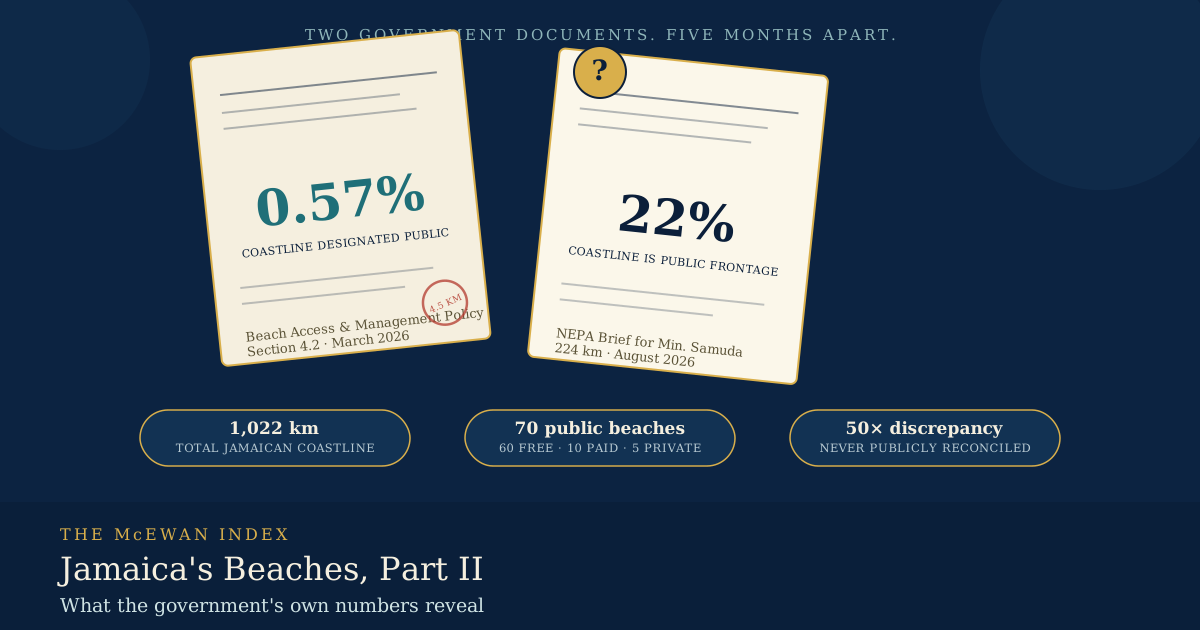
The same Observer report noted, citing official data, that Jamaica has approximately 1,022 kilometres of coastline, of which about 29 per cent, or roughly 300 kilometres, is sandy beach. That figure matters. It is the denominator against which every access percentage in this debate, government or activist, should be measured, and as this piece shows, almost nobody uses it.
Bartlett was not addressing a hypothetical. For two years, international outlets including Al Jazeera, ITV News and NPR-affiliated Here & Now have run segments built around the claim, advanced by the advocacy group Jamaica Beach Birthright Environmental Movement (JaBBEM), that less than one per cent of Jamaica's coastline is freely accessible to ordinary Jamaicans. That claim, and the minister's rebuttal of it, are the two poles of this debate. Neither survives close reading intact.
The Definitions Jamaica Keeps Skipping
Much of the noise in this debate comes from treating "access" as one thing. It is not. Jamaican law and practice distinguish several concepts that get collapsed into a single word online.
Public beach, in the strict legal sense, means a beach the Minister has declared a "public recreational beach" under section 52 of the Beach Control Act, 1956. Not every beach Jamaicans call public carries this designation. Some are simply beaches nobody has fenced off yet.
Public access means the public is legally and physically entitled to reach the shoreline. It does not by itself say anything about cost.
Free access means no admission is charged. A beach can be public without being free, and in a narrow but real sense, free without being formally public.
A paid public beach is not a contradiction. A beach can remain legally public while a licensed operator, whether a municipal corporation, a state agency, or a private concessionaire, charges a fee that funds lifeguards, washrooms, security, or waste collection. Puerto Seco Beach in Discovery Bay, St Ann, discussed below, is exactly this.
A privately operated beach is one where a licensed private entity manages day-to-day use, typically a hotel or a commercial operator, under a licence issued under the Act. The land beneath the high-water mark still belongs to the Crown regardless of who runs the gate.
Private property adjacent to the beach is a separate matter from control of the foreshore, which the Act defines as the strip between the high-water and low-water marks. Owning beachfront land does not, in law, transfer ownership of the foreshore or the seabed. What it can transfer, in practice, is control of the only reasonable route to reach that foreshore, which is where most real-world grievances actually live.
The seabed, or floor of the sea, is likewise vested in the Crown under section 3 of the Act, distinct from any adjoining private land.
Finally, the debate needs to separate physical access (can you get your feet on the sand), visual access (can you see the coastline from a public road, or is it walled off), and functional access (can a fisher launch a boat, a vendor sell food, an elderly person or a person with a disability actually use the space). A beach can score well on one of these and badly on the others. Much of Jamaica's argument happens because two people are scoring different dimensions and calling it the same argument.
What the Law Actually Says
The Beach Control Act, 1956, is Jamaica's foundational beach statute, still in force with amendments including a 1973 update. It is frequently summarised online as "the law that privatised Jamaica's beaches." That is not accurate, and getting it wrong obscures what the law really does.
Section 3 vests all rights in the foreshore and the floor of the sea in the Crown. Section 4 preserves a narrow customary right: an owner or occupier of land adjoining the foreshore, together with family and private guests, may use the adjoining foreshore for private domestic bathing, fishing and access to the sea. Section 5 prohibits any encroachment on, or commercial use of, the foreshore or seabed without a licence. The Act establishes the Beach Control Authority to administer licensing, "in the interests of the public and of persons who have acquired rights therein."
Crucially, the Act does not, on its own, create a general public right to roam any beach in Jamaica. A summary published by the environmental advocacy site Big Up Wi Beach Ja notes that the public has unrestricted access only to beaches specifically declared "public recreational beaches" under section 52, and even then, access can be conditioned on a licence fee if one has been set. Everywhere else, use depends on licences issued to hotels, commercial operators, or fishing communities.
Subsidiary regulations flesh this structure out. The Beach Control (Hotel, Commercial and Public Recreational Beaches) Regulations, 1978, govern licensed commercial and hotel beaches; these do not apply to Jamaica's roughly 121 designated fishing beaches, which fall under separate licensing arrangements administered historically by the Ministry of Agriculture and now NEPA. A licence cannot legally be granted, under section 5(2b) of the Act, if the Authority certifies that it would conflict with the public interest in fishing, bathing, recreation, or environmental protection. On paper, the law already contains a public-interest check on private encroachment. Whether that check has been consistently applied, and by whom, is a separate and largely unanswered question, because Jamaica does not publish a running public audit of licensing decisions against that standard.
NEPA, formed later as the successor administrative body working with the Natural Resources Conservation Authority (NRCA), now handles environmental approvals for coastal development and maintains the official beach registry, though as shown below, even that registry has produced inconsistent counts over time.
The government's own framing, that the Beach Control Authority was meant to balance hotel-driven commercial development against public recreation, fishing rights and access to the sea, is accurate as a description of legislative intent. Whether the modern licensing system has achieved that balance in practice is the actual question at the centre of this debate, and it cannot be answered by reading the statute alone.
2019: Jamaica Already Diagnosed the Problem
In 2019, NEPA published a Green Paper titled "Towards a Beach Policy for Jamaica," explicitly framed as a policy for the use of the foreshore and floor of the sea. Its stated purpose was blunt for a government document: to "remove any vestige of real or implied discrimination against Jamaicans in the use and enjoyment of their national heritage," to expand recreational access for both residents and tourists, and to protect fishers' traditional rights to the foreshore and to beaching their catch.
The document is explicit that "earlier policies for the management of the foreshore resulted in the separation of visitors and residents through a system of exclusive licences and consequently barred Jamaicans from enjoying some of the finest beaches in the country." This is a government agency, in an official policy paper, conceding the substance of what activists have been arguing for years. It is not a fringe claim. It is NEPA's own diagnosis.
That raises the obvious question the master brief for this piece insists on asking. If Jamaica identified this problem by 2019 at the latest, why is the country still fighting about the same issue in 2026? The honest answer, based on the public record, is a mixture of causes rather than one villain. The 2019 Green Paper did not become binding legislation. A follow-on Green Paper process, run under Minister Pearnel Charles Jr in the Ministry of Housing, Urban Renewal, Environment and Climate Change, held public town halls into 2021 but produced no enacted law. Responsibility for the file then moved again, to a newly configured Ministry under Minister Matthew Samuda's successor portfolio arrangements, before Prime Minister Andrew Holness personally tabled a fresh Beach Access and Management Policy in March 2026. Five years, at minimum, passed between a government agency naming the problem in writing and a policy document reaching Parliament. That gap is not explained by any single cause in the record: it reflects institutional churn (the file moved ministries at least twice), the absence of a legislative deadline forcing action, and the low political cost of leaving a colonial-era statute unamended so long as no single crisis forced the issue. Readers should treat any single-cause explanation for the delay, whether "political will" or "bureaucracy," as an oversimplification the public record does not support.
The 2026 Beach Access and Management Policy
Holness tabled the Beach Access and Management Policy for Jamaica (BAMP) during the 2026/27 Budget Debate in March, telling the House that "the Beach Control Act of 1956 and its amendment in 1973 did not adequately address beach access issues, and will have to be replaced."
The policy document itself, prepared under the Ministry now responsible for the environment portfolio, sets out to develop modern, legally precise definitions of a beach, the foreshore, the backshore, and the "water shelf," none of which the 1956 Act defines with the specificity the policy argues is needed. It commits NEPA to publishing, in its annual reports tabled in Parliament, a "detailed report on the status of the island's public bathing and recreational beaches," effectively creating the first standing, parliament-facing public accounting mechanism the sector has had. It directs the Tourism Product Development Company (TPDCo) and the Tourism Enhancement Fund (TEF) to identify and prioritise beaches for rehabilitation to expand public access. It grounds the policy explicitly in the Charter of Fundamental Rights and Freedoms in Chapter III of the Constitution, and situates it within National Outcome 13 of the Vision 2030 National Development Plan.
The most contested provision addresses hotel beaches directly. The policy states that "hotels will be encouraged to implement a beach pass system to facilitate access by the public to hotel beaches, at a reasonable fee, to persons who are not guests of the hotel," with the fee structure set in consultation with NEPA. Note the word "encouraged." As drafted, this is not a mandatory requirement; it is a policy preference the government hopes hotels will adopt voluntarily, which is itself a meaningful limitation activists have seized on.
The reaction split along predictable but substantively different lines. JaBBEM's president, Dr Devon Taylor, rejected the policy outright, arguing that because the foreshore is constitutionally vested in the Crown as a trust for the people, no hotel has standing to charge for access to it at all, only for the amenities, such as washrooms, that the hotel itself built. He pointed to Barbados, St Kitts and Nevis, the Bahamas and the Cayman Islands as regional examples of free-beach regimes that, in his account, function without the "chaos" the tourism industry warns against, though he did not cite comparative data to support that claim, and this piece could not independently verify operating outcomes in those jurisdictions within the scope of this investigation. Taylor also objected specifically to artificial beach construction, calling for a moratorium and an independent ecological audit.
Opposition spokesman on the environment Omar Newell took a more incremental line, arguing during the Sectoral Debate that the policy "still approaches beach access as a managed permission rather than a fundamental public right," and calling for guaranteed public access corridors, legal protection for traditional fishing communities, protected easements, and a national access map. Newell's critique is narrower than JaBBEM's: he accepts the policy framework in principle but argues its guarantees are too weak, whereas JaBBEM rejects the framework's premise.
Neither critique should be read as an established fact about the policy's ultimate effect, because BAMP has not yet passed into law and its enforcement mechanisms have not been tested. What can be said with confidence, because it is on the face of the document, is that the policy relies heavily on "encouragement" rather than mandate for the hotel sector, and that its accountability mechanism (NEPA's annual reporting requirement) is new and has not yet produced a single published report to evaluate.
Free Beaches, Paid Beaches: What Actually Happens
This is the empirical core of the debate, and it deserves an empirical answer rather than an ideological one. What does the record actually show about free versus paid beaches in Jamaica?
Winnifred Beach, Portland, is the country's most-cited free public beach and a useful test case precisely because its "free" status was fought for, not given. The land was willed in 1918 by a Baptist missionary for the benefit of the local community, passed to the Attorney General as trustee in 1938, and was sold, along with surrounding land, to the Urban Development Corporation (UDC) in the 1970s. When the UDC moved to develop the beach commercially in 2007, five members of the Free Winnifred Beach Benevolent Society (FWBBS), formed by local vendors and residents, filed a claim asserting the public's prescriptive right of access. The matter was resolved by consent order in 2015: the UDC granted an easement, recorded on the title, guaranteeing that Winnifred will remain a public bathing beach in perpetuity. Since then, the FWBBS, without UDC funding, has trained lifeguards, organised waste disposal and recycling, and managed the beach's vendors. The beach won the Jamaica Environmental Action Award for Best Environmental Community in 2011. Winnifred is not evidence that free beaches maintain themselves. It is evidence that a specific, organised, locally accountable management structure, backed eventually by a legal settlement, can keep a free beach clean and functional. Remove that structure and there is no reason to assume the outcome would be the same.
Puerto Seco Beach, Discovery Bay, St Ann, illustrates the paid-facilities model. It charges JMD $2,000 for adults and $1,000 for children aged five to eleven, plus a refundable JMD $500 locker deposit. That buys access to showers, changing rooms, lifeguards, a water park with a slide and trampoline, glass-bottom boat rides, kayaking, food vendors and a spa. The letters pages of the Gleaner recall that Puerto Seco was leased to a private operator in 2015, with local complaints at the time about the resulting entrance fee curtailing "average Jamaicans' reasonable access." A decade on, the fee has become an accepted part of the beach's identity, but a 2026 TripAdvisor review documents a visitor being charged $2,000 after being told the price was $1,000, with staff offering no explanation for the discrepancy. That single, unverified consumer complaint should not be treated as proof of systemic mismanagement, but it is a useful caution against assuming a fee structure is self-enforcing or transparent simply because it exists.
Doctor's Cave Beach, Montego Bay, run by the Doctor's Cave Bathing Club, charges US$6 for adults and US$3 for children. It is one of Jamaica's oldest managed bathing beaches, dating to the early twentieth century, and has operated on a membership-club-plus-day-fee model for generations without the kind of public controversy attached to more recently enclosed beaches. Its longevity suggests that a modest, transparent, long-standing fee structure can coexist with broad public tolerance, provided the public understands what the fee is for and the arrangement predates the current wave of resort-driven land consolidation.
Hellshire Beach, St Catherine, is the counterexample activists most often reach for: a large, well-known, nominally free and heavily used public beach that has nonetheless suffered from inconsistent sanitation, informal vending infrastructure, and periodic environmental degradation, problems documented across years of Jamaican press coverage of the wider Hellshire coastal area. Hellshire is public, it is largely free, and it has not been consistently well maintained. That fact alone is enough to falsify the claim, sometimes implied by tourism-sector defenders, that free-of-charge automatically means poorly kept, and the inverse claim, sometimes implied by activists, that free beaches inherently thrive once liberated from commercial control. Both Winnifred and Hellshire are technically free and community-adjacent. Only one is consistently well run. The difference is organisation and investment, not the presence or absence of a price tag.
Bob Marley Beach, Bull Bay, St Thomas, and Blue Lagoon, Portland, represent the sharpest edge of the dispute: active litigation. JaBBEM's case tracker lists ongoing matters over Blue Lagoon Beach at the Portland Parish Court, with hearing dates running through September 2026, and over Bob Marley Beach at the Kingston Sutton Street Parish Court. British-Jamaican claimant Norman Stephenson has separately pursued legal action to prevent development on land at Bull Bay he says belongs to his family, describing resistance to a proposed £160 million resort. Statutory bodies, including the Commissioner of Lands and the Jamaica National Heritage Trust, are named as defendants in these matters alongside private developers, which is itself notable: this is not simply "activists versus a hotel." It involves the state's own land administration apparatus. These cases remain before the courts. This piece treats the underlying ownership and access claims as unresolved allegations, not established facts, precisely because that is their current legal status.
Harmony Beach Park, Montego Bay, appears in the Observer's own August 8 report as the photograph accompanying the "Hurting Jamaica" story, captioned as entry fee-free and featuring an inflatable obstacle course. It represents a newer model: a purpose-built municipal-style public recreation space rather than a converted historic bathing beach, funded through public investment. Marking Stone Beach in Annotto Bay, St Mary, upgraded by the Tourism Enhancement Fund at a cost of J$38.3 million and opened to the public in 2018, is a comparable example of direct public capital producing a free facility. Both suggest that where government chooses to invest directly rather than license out, free and reasonably maintained public beaches are achievable. The limiting factor in these cases has been the volume of investment, not the absence of a viable model.
Comparative Table
| Beach | Parish | Access Type | Fee | Facilities | Management | Key Issue |
|---|---|---|---|---|---|---|
| Winnifred Beach | Portland | Public, free (donations welcomed) | None; voluntary donation | Showers, changing rooms, food vendors, trained lifeguards | UDC ownership; community-run under 2015 consent order and easement | Model for community management, but rests on a hard-won legal settlement |
| Puerto Seco Beach | St Ann | Licensed public recreational beach, private operator | JMD $2,000 adult / $1,000 child | Water park, glass-bottom boats, kayaking, showers, lockers, food | Private concessionaire (Dolphin Cove) under state land arrangement | Fee funds amenities; pricing consistency questioned in visitor reports |
| Doctor's Cave Beach | St James | Licensed bathing club | US$6 adult / US$3 child | Long-established changing facilities, lifeguards, grounds | Doctor's Cave Bathing Club | Long-running, low-controversy fee model |
| Hellshire Beach | St Catherine | Public, largely free | None at most access points | Inconsistent; informal vending, variable sanitation | Mixed public/informal management | Free access without reliable maintenance investment |
| Bob Marley Beach | St Thomas | Disputed; customary/community use | N/A, contested | Informal | Contested between community claimants, developer, state land bodies | Active litigation; ownership and access rights unresolved |
| Blue Lagoon | Portland | Disputed public bathing beach | N/A, contested | Limited | Contested; court proceedings ongoing through 2026 | Active litigation over adverse possession and access |
| Harmony Beach Park | St James | Public, free | None | Modern park facilities, inflatable obstacle course | Municipal/public investment | Model for direct public investment in free access |
Do Jamaicans Treat Free Beaches Differently? An Honest Look
This is the uncomfortable section the brief for this piece insists on, and it deserves an honest, non-stereotyping answer rather than an evasive one.
The Hellshire and Winnifred comparison above already supplies the core finding: the presence or absence of a fee does not by itself predict whether a beach is well kept. What predicts it, on the available evidence, is whether someone, a community organisation, a licensed operator, or a state agency, has taken clear, funded, accountable responsibility for daily upkeep. Winnifred works because the FWBBS built a functioning informal institution around a free beach, training its own lifeguards and running its own recycling programme without waiting for the UDC to do it. Where that kind of organisation does not exist, free beaches are exposed to the textbook economic problem of an unmanaged common resource: nobody has a direct financial stake in its upkeep, so upkeep depends entirely on either voluntary civic effort or public budget allocation, both of which are unreliable relative to a paying customer's expectation that facilities work.
This is not a claim that Jamaicans, culturally, treat public property carelessly. It would be bad economics and worse social science to draw a national character conclusion from a handful of case studies. It is a narrower and more defensible claim: Jamaica shares, with almost every country, the general pattern economists call the tragedy of the commons, in which a resource that is collectively owned but nobody in particular is accountable for tends to be under-maintained relative to one where a specific party bears the cost of neglect and captures the benefit of upkeep. That dynamic is visible well beyond beaches, in the state of some public parks, road verges, and stormwater drains across the island, and treating the beach debate as a uniquely coastal failing misses the more general, and more useful, pattern.
The fairer framing, and the one the evidence supports, is this: charging a fee is one way, but not the only way, to solve the accountability problem, because a fee gives an operator revenue and a customer-facing incentive to maintain quality. Community management with a formal legal mandate, as at Winnifred, can solve it too, but requires sustained organisational effort that not every community has the capacity to sustain unaided. Direct public investment, as at Harmony Beach Park and Marking Stone Beach, can also solve it, but requires the state to keep funding maintenance indefinitely, which competes against every other government priority. None of the three models is a free lunch. Each substitutes a different kind of ongoing cost, financial, organisational, or fiscal, for the alternative of leaving a resource unmanaged.
The Economics of Running a Beach
A beach that people actually want to use is not costless to operate. Lifeguards need salaries and training. Public washrooms need water, sewage connections and daily cleaning. Waste collection has to happen regardless of whether anyone paid to enter. Parking areas need surfacing and security. Erosion management, particularly relevant given Jamaica's exposure to storms including the 2025 Hurricane Melissa, referenced directly in Bartlett's own remarks, requires ongoing coastal engineering. None of this is available at reliable, publicly audited per-beach cost figures in Jamaica; no Jamaican government body appears to publish a standard cost-per-beach maintenance benchmark, which is itself a policy gap worth naming rather than papering over with an invented number.
What can be said, without inventing a figure, is that these costs scale with visitor volume and with the quality of experience a beach offers. A beach with a water park, lifeguards and daily-cleaned washrooms, like Puerto Seco, costs meaningfully more to run than an unimproved stretch of sand with a single access path, and its fee structure reflects that difference in kind rather than mere gatekeeping.
Several financing models exist in practice or in the policy conversation, each with real trade-offs rather than an obvious winner:
A fully tax-funded free model maximises equity of access but requires the government to compete for scarce fiscal resources against health, education, security and infrastructure, and Jamaica's public finances, still working through post-Melissa reconstruction pressures, are not obviously positioned to absorb a large new standing commitment.
A free shoreline with paid facilities model, which is close to what Puerto Seco and Doctor's Cave already do, preserves the constitutional and legal principle that the foreshore itself cannot be sold while letting operators recover the real cost of amenities from the people who use them.
Low-cost public admission, a small, capped, published fee applied uniformly, is close to what JaBBEM's own counter-proposal implicitly resembles when it argues hotels should charge for washrooms rather than for the sand itself, which is a version of user-pays-for-services rather than user-pays-for-access.
A public-private partnership model, where a licensed operator invests capital in exchange for a defined, published, time-limited concession with binding public-access guarantees, is closest to what BAMP's hotel beach-pass proposal gestures toward, though its current "encouraged" rather than mandatory language weakens the guarantee considerably.
Community management agreements, formalised versions of the Winnifred arrangement, extend a working model that already exists but currently rests on one hard-fought legal settlement rather than a general legal template other communities could adopt without repeating years of litigation.
The single most useful intellectual move this article can offer readers is this distinction, and it deserves to be stated plainly: a fee for access is not automatically the same thing as privatisation, and calling a beach "public" does not automatically make its access meaningful. A beach can remain legally, constitutionally public, foreshore vested in the Crown, licence subject to public-interest review, while charging a reasonable, transparent fee that funds real infrastructure. Equally, a beach can be formally designated "public" on a NEPA list while practically unreachable, because the only access road runs through a gated hotel property, because there is no signage, or because the nearest public transport does not go anywhere near it. Jamaicans arguing past each other in this debate are very often correct about their half of this distinction and wrong to assume it settles the whole argument.
Tourism and Public Access Are Not Opposites
It is tempting, and wrong, to frame this as tourism against Jamaicans. Tourism is not a foreign imposition on the economy; it is one of its largest employers and foreign-exchange earners, and the Ministry of Tourism's budget allocation of over J$16 billion for 2025/26, including funding specifically earmarked for beach development through the Tourism Enhancement Fund, is itself evidence that beaches are treated as an economic asset requiring active public investment, not merely a private commodity left to hotels. Hurricane Melissa's 2025 damage to tourism infrastructure, and the sector's ongoing recovery, referenced across Jamaica Tourist Board investor materials for 2026, underscore how much of the island's employment and export earnings run through this single sector.
At the same time, tourism development creates the exact pressures activists describe: land consolidation, visual and physical barriers, displacement of fishing communities, and congestion at the small number of beaches everyone agrees are genuinely free. The Gleaner's 2018 letters exchange over Cornwall Beach, Rose Hall, Damali Beach and the 2015 Puerto Seco lease documents a real, decades-long pattern in which specific named beaches moved from broadly local use to restricted commercial use, sometimes under one political administration, sometimes under another, without the consultation process communities say they were promised. That pattern is not activist invention. It is a matter of public record spanning multiple governments, and treating it as a partisan talking point rather than a documented administrative history does a disservice to the communities involved.
The honest synthesis is that Jamaica does not face a binary choice between a globally competitive tourism sector and meaningful public coastal access. It faces a harder, more specific policy design problem: how to expand and guarantee free and low-cost public access at a defined, growing set of beaches, while allowing licensed commercial development to continue at others, with transparent rules for which is which, published in advance rather than discovered after a gate goes up.
The 1% Claim, Examined
JaBBEM's claim that less than one per cent of Jamaica's coastline is freely accessible to the public has travelled further and faster than any other statistic in this debate, cited by Al Jazeera in 2024, by ITV News and WBUR's Here & Now in July 2026, and repeated across social media and at least one European outlet. It deserves the same scrutiny this piece has applied to the government's numbers.
Tracing the claim across its own advocates' public statements over time reveals it has not been stable. In 2024, JaBBEM and allied commentary cited a figure of 0.6 per cent, described as three miles of free coastline out of 494 miles total. By July 2026, JaBBEM president Devon Taylor was citing "2.8 miles of coastline" out of the same roughly 494-mile total, still summarised in press coverage as "less than 1%." Both versions of the claim rest on the same approximate 494-mile coastline figure, a number this piece could not trace to a specific, published, methodologically documented NEPA or STATIN source. It appears consistently in activist and international press materials but not in the Jamaica Observer's own August 2026 figure, sourced to official data, of 1,022 kilometres of coastline, which converts to roughly 635 miles, close to 30 per cent higher than the figure underlying the 1% claim.
That discrepancy matters enormously to the arithmetic. Using JaBBEM's own numerator of under three miles against the higher, Observer-cited denominator of 635 miles would still yield well under one per cent, so the headline conclusion is not obviously overturned by the discrepancy. But it does mean the claim has been repeated across major international outlets for two years without a single publicly available, footnoted methodology explaining what "coastline," "beach," and "freely accessible" specifically mean in the calculation, whether it counts only sandy beach or all coastline including rocky and cliff sections, and whether "freely accessible" means physically reachable, legally guaranteed, or both. Given this piece's own standard, that no figure should be repeated as fact without a verifiable original source, the honest verdict is that the underlying arithmetic direction (a small minority of the coastline is genuinely free and unrestricted) is plausible and consistent with the case-study evidence above, but the precise "1%" figure itself is unverified as a rigorously sourced measurement and should be treated as an advocacy estimate rather than an official statistic.
That is not a minor technical footnote. It is a case study, in miniature, of how a plausible but methodologically opaque number becomes an unassailable international talking point through repetition alone, which is precisely the dynamic Minister Bartlett was gesturing at, however imprecisely, when he complained about international coverage.
The Government's Numbers, Examined With the Same Rigour
Bartlett's figures deserve identical treatment, not softer treatment because they came from a minister rather than an activist.
The claim of 70 public bathing beaches, with 10 paid and five charging significant fees, was delivered as a spoken remark at a food festival, not as a citation to a specific NEPA report or published list. That matters for evidentiary weight: it is a minister's characterisation, not a document this piece could independently retrieve and check line by line. NEPA's own historical published figure, reported in 2017, was 86 public bathing beaches, sourced to the agency's own beach guide materials. The BAMP Green Paper tabled in Parliament in 2026 contains an appendix titled "List of Bathing Beaches in Jamaica," which would be the authoritative current source, but this piece was unable to access the full appendix content to confirm whether it lists 70, 86, or some other number. Until that appendix, or an equivalent current NEPA registry, is publicly verified against Bartlett's figure, the honest verdict is that his count is plausible but unverified, and the apparent nine-year drop from 86 to 70 could reflect reclassification, beach loss, a different counting methodology, or simple imprecision in an off-the-cuff speech. All four explanations are consistent with the public record; none can be confirmed from it.
The claim that only 10 of 70 are "paid" is similarly unverifiable without the underlying list, and carries the same definitional ambiguity this piece has stressed throughout: does "paid" mean an entrance fee for the beach itself, as at Puerto Seco, or does it also capture facility fees, locker deposits, or the many hotel beaches where non-guests can access the sand freely along the wet-sand margin under the section 4 rights described earlier, but cannot use hotel amenities without paying? The minister's remarks did not specify a methodology, and this piece will not supply one on his behalf.
The claim that "only five charge a decent money" is, on its face, an opinion rather than a fact. "Decent money" is not a defined threshold; it is Bartlett's own characterisation of what counts as expensive. It is entirely reasonable as rhetoric in a speech aimed at reassuring an audience. It is not a verifiable statistic, and should not be repeated as one.
Fact-Checking the Beach Debate
| Claim | Source | Evidence | Verdict |
|---|---|---|---|
| "Jamaica has 70 public bathing beaches" | Tourism Minister Edmund Bartlett, Aug 8, 2026 speech | No published list cited; NEPA's 2017 published figure was 86; BAMP appendix not independently verified by this piece | UNVERIFIED |
| "Only 10 of those are paid beaches" | Same speech | No published methodology; ambiguous whether "paid" means entrance or facility fees | UNVERIFIED / CONTEXT REQUIRED |
| "Only five charge a decent [significant] amount" | Same speech | "Decent money" is undefined and subjective | OPINION, not a verifiable statistic |
| "Less than 1% of Jamaica's beaches/coastline are freely accessible" | JaBBEM (Devon Taylor), cited by Al Jazeera, ITV News, Here & Now, 2024-2026 | Underlying figure (2.8-3 miles of ~494 miles) not traced to a published, footnoted methodology; denominator differs from official 1,022km/635-mile coastline figure cited by Jamaica Observer | MISLEADING AS STATED / DIRECTION PLAUSIBLE, PRECISE FIGURE UNVERIFIED |
| "Jamaica's beaches are privately owned" | Common online claim | Beach Control Act section 3 vests the foreshore and seabed in the Crown, not private owners | FALSE |
| "All [Jamaican] beaches are public" | Common online claim | Many operate under hotel/commercial licences with lawful restricted use under the 1978 Regulations; roughly 121 fishing beaches have separate licensing | FALSE |
| "A paid beach is automatically a private beach" | Common framing in the debate | Puerto Seco and Doctor's Cave are licensed, fee-charging, and legally designated public recreational beaches | MISLEADING |
| "Free beaches are necessarily poorly maintained" | Common tourism-sector framing | Winnifred Beach is free and well-regarded due to organised community management | FALSE |
| "Paid beaches are necessarily better maintained" | Common counter-framing | Doctor's Cave and Puerto Seco are generally well-kept, but Puerto Seco has documented pricing-consistency complaints; maintenance quality tracks management accountability, not price alone | CONTEXT REQUIRED |
The Human Dimension
None of this is abstract for the people who live it. A Kingston family pricing out a Sunday beach trip is doing real household budgeting, not making a political statement. A fisher in St Thomas whose customary launch point sits inside a proposed resort footprint is not weighing in on a policy debate; he is weighing whether his livelihood survives the next licence approval. A vendor at Winnifred Beach who trained as a volunteer lifeguard because no one else would fund one is providing a public service the state has not fully funded. An elderly Jamaican or a person with a disability trying to reach a beach without a paved access road experiences a form of exclusion that neither Bartlett's percentages nor JaBBEM's percentages capture, because functional access rarely shows up in a coastline-length calculation at all.
A beach, in other words, is simultaneously a recreational amenity, an environmental system, a tourism export, a cultural touchstone tied to figures like Bob Marley, a workplace for vendors and hotel staff, and in Jamaican constitutional language, a piece of "national heritage." A policy conversation that reduces it to a single percentage, in either direction, is going to misrepresent someone's stake in the outcome.
What the Public Owes
The brief for this piece insists on a section that many outlets avoid: what obligations come with a public right to the beach. It would be intellectually dishonest to build a case for expanded access without also asking what happens when access is granted and not respected.
Hellshire's documented struggles with informal dumping and inconsistent sanitation are not solely a government failure of investment, though they are partly that. They also reflect the broader Jamaican pattern of underinvestment in the civic habits that keep shared, unpriced public goods usable: litter disposal, respect for vending regulations, adherence to safety rules, and reporting rather than tolerating illegal dumping. This is the textbook "tragedy of the commons" in plain language: when a resource belongs to everyone and no one in particular, and using it carelessly costs the individual nothing while degrading it for everyone, individually rational behaviour can produce a collectively worse outcome. It is not a Jamaica-specific failing. It is why parks, drains, sidewalks and public transit infrastructure worldwide degrade faster than privately owned equivalents unless a specific accountable party, public or community, is funded and empowered to maintain them.
The same pattern shows up elsewhere in Jamaican public life, in the condition of some urban drains, parks and public sanitary facilities, which suggests the underlying issue is not really about beaches at all. It is about how Jamaica funds and enforces stewardship of anything held in common. Recognising that connects the beach debate to a much larger and more useful national conversation than either side of the current argument is currently having.
What Government Owes
None of the above excuses government from its side of the bargain. NEPA's own 2019 admission that "exclusive licences" historically barred Jamaicans from their best beaches is a government failure of policy design, not a citizen failure of behaviour. The five-plus-year gap between that admission and a tabled replacement policy is a failure of institutional follow-through. The absence of a single published, current, authoritative, publicly accessible list of every designated public bathing beach with its access rules and fee status, the very document this piece needed and could not fully verify, is itself a government transparency failure that fuels exactly the kind of statistical dispute this article has spent several thousand words trying to untangle.
Government cannot reasonably ask citizens to behave responsibly toward public beaches while failing to fund the washrooms, lifeguards and waste collection that make responsible use physically possible. Equally, citizens cannot reasonably demand world-class, free, fully maintained public beaches everywhere without accepting that quality costs money, whether raised through general taxation, a transparent user fee, or a genuine, funded community-management partnership modelled on Winnifred's hard-won settlement.
The Tourism Sector's Share of the Obligation
Hotels and private operators are not exempt from this reckoning either, but demonising them misreads the record as much as excusing them does. The Jamaica Hotel and Tourist Association's stated position, that "a world-class tourism product and meaningful public beach access are complementary national priorities that can and should be advanced together," is a defensible position in principle. Whether individual operators have lived up to it is a case-by-case question the litigation over Bob Marley Beach, Blue Lagoon and Providence Beach in Montego Bay is actively testing in court right now, and this piece will not pre-judge outcomes that remain before Jamaican courts.
What can fairly be asked of the sector, consistent with the section 5(2b) public-interest test already written into the 1956 Act, is that new licences and developments demonstrate concretely that they do not conflict with public fishing, bathing and recreational interests, that access points be clearly signed and genuinely usable rather than nominal, and that where a beach pass system is adopted, its pricing be published and consistent, addressing the exact kind of pricing confusion documented in the Puerto Seco visitor complaint above.
The Class Question
There is an uncomfortable arithmetic underneath this entire debate. A family that can afford a J$2,000 Puerto Seco entry fee, or a hotel day pass running considerably higher, has meaningfully more beach options than a family working with a tighter Sunday budget. That is not speculation; it follows directly from the fee structures documented above. Left unaddressed, a system that relies primarily on paid access risks turning Jamaica's coastline, held in trust for the nation under the very Crown-vesting language both sides of this debate cite, into a good that its highest-income citizens and foreign visitors experience more fully than everyone else.
The answer to that risk is not necessarily to eliminate every fee everywhere, which the financing analysis above shows would create its own sustainability problem. It is to guarantee, as a matter of published policy rather than accident, a sufficient, well-distributed, genuinely free network of high-quality beaches, one meeting Newell's call for guaranteed access corridors in every parish, so that fee-based beaches remain a choice rather than the only reliable option.
A Realistic Framework, Not a Slogan
Building on the evidence above, and consistent with the direction BAMP already points but has not yet mandated, a workable Jamaican framework would include a small number of concrete, achievable commitments: a guaranteed minimum of at least one high-quality, genuinely free public recreational beach in every parish, funded directly rather than left to licensing revenue; a published, current, single national list of every designated public bathing beach with its legal status, access route and fee (if any), removing the ambiguity this piece has had to work around at every turn; a mandatory rather than merely "encouraged" public-access requirement for new coastal hotel developments above a defined size, with published, NEPA-approved, capped pricing where a fee applies; formal extension of the Winnifred-style community-management-agreement model to other communities willing to organise around it, backed by a legal template rather than requiring each community to litigate its own consent order from scratch; protected, mapped and legally secured access corridors and fishing-beach rights, addressing Newell's central objection directly; and an annual, independently reviewed public report, building on BAMP's NEPA reporting requirement, that tracks beach condition, access, and revenue use against these commitments.
None of this requires resolving the ideological argument between "the sea belongs to Jamaica, full stop" and "hotel investment requires predictable returns." It requires Jamaica to stop treating beach policy as a rhetorical battlefield and start treating it as an ordinary, if unusually emotionally charged, public infrastructure problem: define the asset, publish its status, fund its maintenance, and hold whoever manages it, government, community or private operator, accountable to a published standard.
The Information War, and Its Limits
Return to the word that titled the Observer's report: hurting. Bartlett's underlying worry, that inaccurate international narratives can damage Jamaica's tourism brand, investor confidence and destination reputation, is not an unreasonable one for a tourism minister to hold, and the government's own spending on corrective advertising suggests officials treat the reputational cost as real rather than rhetorical.
But the opposite failure is equally real and equally damaging. A country does not protect its international reputation by dismissing every uncomfortable question as misinformation, particularly when, as this piece has shown, the underlying documented pattern of specific beaches moving from community use to restricted commercial access across multiple administrations is not itself in dispute. Misinformation is harmful. Treating legitimate, evidenced grievances as if they were misinformation, simply because activists have also overstated their case with an imprecise statistic, is a different and equally corrosive harm. Both deserve equal skepticism, and neither deserves the benefit of automatic belief.
The Bigger Question
Strip away the percentages and this becomes a question about what kind of country Jamaica intends to be on its 64th year of independence. A Jamaica where the coastline is accessible mainly to those who can pay for it, or one where it is publicly accessible and professionally managed. A Jamaica where everything held in common is technically free but practically neglected, or one where citizens accept that quality public goods require funding, whether through fees, taxes, or organised community stewardship, and in return receive facilities that actually work. A Jamaica where tourism growth quietly displaces the communities living beside it, or one where investment and public access are written into the same approval process rather than treated as competing interests to be traded off after the fact.
Jamaica Does Not Need a Beach War. It Needs a Beach Compact.
The evidence gathered here does not hand a clean victory to either side of this argument, and a rigorous piece should say so plainly. Bartlett is right that Jamaica is not a country where "every beach is locked off," and the case studies here, Winnifred, Doctor's Cave, Harmony Beach Park, Marking Stone Beach, back him up. JaBBEM and Newell are right that a real, documented, decades-long pattern of specific beach enclosures exists, that the law governing it is a colonial-era statute still awaiting full replacement, and that the government's own 2019 policy paper admitted as much in writing.
What the country actually needs is not a winner in this argument but a compact among government, citizens, communities, fisherfolk, tourism operators, private investors and environmental groups, built on three principles this investigation supports rather than merely asserts. First, the Jamaican public must have meaningful, not merely theoretical, access to its coastline. Second, quality public beaches require money, competent management and public accountability, and pretending otherwise sets every model, free or paid, up to fail. Third, public access comes with public responsibility, and pretending that citizens bear no obligation toward shared resources is as dishonest as pretending government bears none.
Jamaica's beach debate should never have been about whether Jamaicans deserve the sea. Of course they do. The real question, the one worth Parliament's time, NEPA's data, and this publication's scrutiny, is how to guarantee that access in a way that is legally sound, economically sustainable, environmentally responsible and fair to everyone with a genuine stake in the outcome: the Kingston family looking for an affordable Sunday outing, the fisher whose livelihood depends on a beach he has used for generations, the vendor earning an honest income from the beach economy, and the investor whose capital, deployed responsibly, still has a legitimate place on Jamaica's coast. Jamaica's beaches are neither a costless public good nor a pure commodity. They are a national asset that will only be protected by rights, responsibility, investment and stewardship, applied together, not chosen one at a time.