Jamaica's Beaches, Part II: What the Government's Own Numbers Reveal

A single internal document, obtained for this investigation, does more to settle Jamaica's beach-access argument than either side of it has managed in two years
Janiel McEwan, Economist and Researcher
Part One of this investigation asked a simple question. When the tourism minister says Jamaica has 70 public beaches and activists say less than one per cent of the coastline is free, which number is real. The honest answer, at the time, was that neither claim could be traced to a source anyone could actually check.
That has changed. This investigation has now obtained the document that should have anchored this debate from the start: an internal NEPA brief titled "Public beach availability in Jamaica," prepared in August 2026 for the Minister of Water, Environment and Climate Change, Matthew Samuda, alongside the full 112-page Beach Access and Management Policy for Jamaica, tabled in Parliament in March 2026, which this investigation has now read in complete form rather than in press summary. Between them, these two documents are the single most important piece of evidence in Jamaica's beach debate, more important than any speech, any activist statistic, or any newspaper report, because they are the government's own internal accounting of its own coastline.
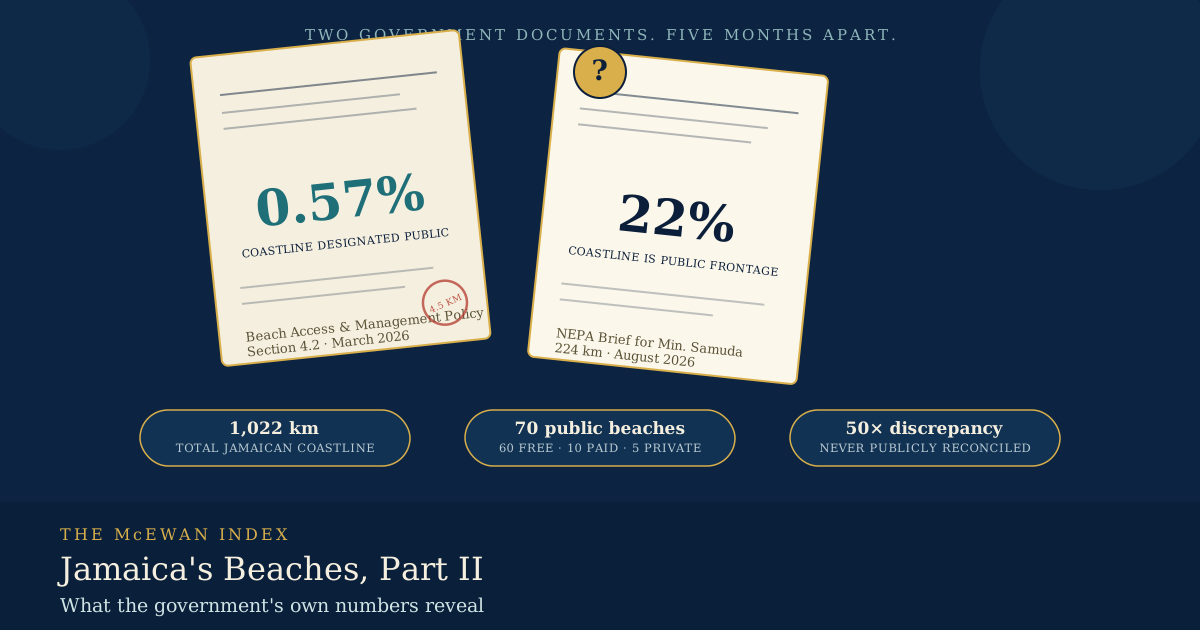
They do not resolve the debate the way either side would like. What they reveal is stranger and, in the end, more useful than a simple verdict for one side. Jamaica's government does not agree with itself about how much of its own coastline is public. One official figure, sitting in the government's own policy document, puts free public beach frontage at under one per cent of the coastline. Another, in a newer internal brief from the same ministry, puts it at 22 per cent. Neither side of Jamaica's beach war appears to have noticed that their opponent's strongest number and their own government's weakest number are, in effect, the same number.
The Document That Should Have Anchored This Debate
The NEPA brief is short, four pages, unglamorous, the kind of document written to sit on a minister's desk rather than to persuade the public. That is precisely what makes it valuable. It was not written to win an argument. It was written to answer one internally, and its findings deserve to be treated as the baseline fact set for everything else in this controversy.
It states, plainly, that Jamaica has 1,022 kilometres of coastline, of which approximately 300 kilometres, or 29 per cent, is sandy beach, a figure drawn from a 2009 national ecosystem gap assessment and therefore now 17 years old. Of that sandy coastline, it states that approximately 224 kilometres, 22 per cent of the total coastline, qualifies as public beach frontage. It then gives the figure that has anchored this entire national argument: 70 recognised public beaches, broken into 60 free "public bathing beaches" and 10 fee-charging "public recreational beaches," with a further five privately owned "commercial recreational beaches," among them Doctor's Cave in Montego Bay, San San in Portland and Frenchman's Cove in Portland, sitting outside the public count entirely.
That last detail corrects something in Part One. This investigation previously treated Doctor's Cave as an example of a public beach charging a fee. The government's current classification places it outside the 70 public beaches altogether, as privately owned land. The distinction matters because it changes how Minister Bartlett's much-repeated formulation, 70 beaches, 10 paid, five charging what he called real money, should actually be read. The 10 are publicly owned beaches with a fee. The five are a separate legal category entirely: private land, not public land that happens to charge more. His phrasing compressed two genuinely distinct categories into what sounded like one nested figure. That is an imprecision worth correcting. It is not the fabrication either side of this debate has assumed it to be.
The brief also carries two admissions easy to miss on a first read and important on a second. A footnote states that not all 70 public beaches presently have the sanitary and safety facilities they are supposed to have. Another explains that additional historical public beach sites are excluded from the current count altogether, some because they have eroded completely, Orange Bay in Portland among them, and others because they remain officially closed by the health authorities over poor water quality, including Gunboat, Buccaneer and Sirgarny beaches in Kingston Harbour. Jamaica's public beach count, in other words, is not simply growing through investment. It is also shrinking through neglect, erosion and pollution, and the "70" figure already reflects that shrinkage rather than hiding it.
The Discrepancy Nobody Has Noticed
Here is the finding that matters most. Section 4.2 of the government's own Beach Access and Management Policy, tabled in Parliament in March 2026, under the heading "The Current Situation and Issues," states: "Jamaica has 795 km (494 miles) of shoreline of which approximately 45% and 35% is characterized as sandy beach and rocky (pebble) shore, respectively. Approximately 4.5 km of the shoreline are designated as public beaches and another 2.88 km used in association with hotels."
Read that again. The government's own policy document says only 4.5 kilometres of Jamaica's shoreline are designated as public beaches. Out of a stated 795-kilometre total, that is 0.57 per cent. Add the 2.88 kilometres associated with hotels and the combined figure comes to 7.38 kilometres, 0.93 per cent of that shoreline total.
That number is, for practical purposes, identical to the claim JaBBEM and international media outlets have repeated for two years as evidence of Jamaicans being locked out of their own coastline. Part One of this investigation could not trace the origin of the specific "under one per cent" figure that has travelled from Al Jazeera to ITV News to WBUR. It now appears very unlikely to be an independent activist calculation at all. The most plausible explanation, based on the numbers actually sitting in the government's own paperwork, is that Jamaica's most viral and most politically damaging beach statistic originated inside the Jamaican government's own policy document, not outside it.
What makes this genuinely strange, rather than simply an embarrassment for whoever first repeated the figure uncritically, is that the very same government apparatus produces a completely different number elsewhere. The newer NEPA brief puts public beach frontage at 224 kilometres, 22 per cent of a larger, 1,022-kilometre coastline total, a figure also independently cited in the Jamaica Observer's own August 8 report on Minister Bartlett's remarks. That is not a rounding difference between two similar estimates. It is a roughly fifty-fold gap, inside the same government, on the same subject, separated by only a few months.
There is a plausible and unremarkable explanation for how this happened, and this investigation will not manufacture a more dramatic one than the evidence supports. The 795-kilometre and 4.5-kilometre figures read like inherited text, carried forward from an older situational survey into successive drafts of the policy without anyone recalculating them against newer data. The document's own drafting history stretches back to at least early 2025 with revisions continuing into 2026, entirely consistent with an old dataset surviving inside a newer document because nobody was tasked with reconciling it. The 1,022-kilometre and 224-kilometre figures, by contrast, appear in the policy's own opening ministerial message and in the newest internal NEPA brief, which suggests they represent the figures government itself currently regards as authoritative.
If that reading is correct, and it is the reading the primary evidence most directly supports, the practical conclusion cuts against government rather than in its favour. The statistic that has done more than any other to damage Jamaica's international reputation on this issue, repeatedly described by Minister Bartlett as misinformation requiring costly correction, was very likely generated from an inconsistency inside Jamaica's own official record. This is not, on the evidence now available, a story of outside disinformation confronting inside accuracy. It is a story of an internal contradiction that outside advocates picked up in good faith, reasonably treated as authoritative because it came from a government policy paper, and have been repeating ever since without government ever identifying, in public, where the number actually came from.
What Is Actually Happening Along the Coast
Away from the statistics, the broader picture that emerges from government's own account of its current programme is more constructive than the public argument suggests, though it comes with real caveats worth stating plainly.
Government describes a pattern, repeated at several sites, of formerly state-owned coastal land being converted for hotel investment with public access preserved as an explicit condition of development, alongside dedicated space set aside for existing beach vendors and limited additional space for new ones under the management of the Tourism Product Development Company. This is presented as the current model for new hotel development on government land, distinct from developments built on artificially constructed beaches, where the policy's own definitions draw a sharper line: the public has no statutory right of access to a manmade beach built by a private investor, a distinction almost entirely absent from the public conversation about beach access to date.
Government also describes a long-planned public beach park and craft village at the western end of Negril's Seven Mile Beach, intended specifically to resolve recurring access tension in that area, alongside further rehabilitation work planned or already tendered for beaches in St Ann, St James, St Mary and elsewhere, building on a programme that began as far back as 2014, when the Tourism Enhancement Fund, the Urban Development Corporation and NEPA jointly committed to safeguarding at least one major beach for local use in every parish. By the end of 2019, that programme had already spent more than J$200 million rehabilitating beaches including Burwood, Marking Stone in St Mary, Lyssons in St Thomas and Boston Beach in Portland. The Negril plan itself is not new. Government officials have described broadly similar plans in budget presentations since at least 2022, and it remains, as of this investigation, at the design and planning stage rather than under construction, a distinction worth holding onto given how long similar announcements have taken to materialise elsewhere on the island.
At Bob Marley Beach in Bull Bay, St Thomas, the site at the centre of active litigation documented in Part One, government has indicated that design work has begun on a better access road, security infrastructure, lifeguard posts and upgraded bathrooms, framed as evidence of an intention to protect rather than enclose the beach. Government has also suggested that the controversial private resort development driving much of the public anger is located a meaningful distance from the beach itself, rather than on it. This investigation has not been able to independently verify that locational claim, or the specific state of the infrastructure design work, and treats both as government assertions requiring confirmation rather than established fact. Given how central this dispute has become to the national conversation, that verification matters, and this publication intends to pursue it.
It is also worth recording plainly that government's own account of implementation is not uniformly reassuring. Even where legal access to a beach exists, officials responsible for the file have acknowledged that signage is often poor and supporting infrastructure worse, a candid admission that lines up precisely with the distinction Part One drew between legal access on paper and functional access in practice. And in April 2026, in Negril itself, a private tenant leasing government-owned land for a watersports concession erected a fence across a public access point, an incident independently reported by the Jamaica Observer and resolved the same day once authorities intervened. That episode is a real, dated, independently sourced example of exactly the pattern of restriction activists describe nationally, sitting alongside evidence that the state, when alerted, can and did act quickly to reverse it.
The Regional Comparison, Now Confirmed
Part One noted that JaBBEM had cited Barbados, the Bahamas, the Cayman Islands, and St Kitts and Nevis as jurisdictions with stronger free-beach guarantees than Jamaica, and stated plainly that it could not verify those comparisons within its original scope. The full BAMP policy resolves that gap, because it contains the government's own comparative legal review, citing statutory text directly rather than secondhand.
St Kitts and Nevis vests all beach rights in the Crown and statutorily guarantees public recreational access, with a further 2020 bill in that jurisdiction declaring all beaches public and making it a punishable offence to fail to maintain public access. Antigua and Barbuda's Physical Planning Act guarantees at least one public landward access point to every beach, backed by the power to compulsorily acquire access rights where none exists. The Virgin Islands' planning legislation contains near-identical language. Barbados guarantees public access to all beaches by law, with private beachfront property extending only to the high-water mark.
Jamaica currently has no equivalent statutory provision. That is not activist rhetoric. It is the conclusion that follows directly from the Jamaican government's own comparative review, sitting inside its own policy document. Where Part One treated the regional comparison as an unverified activist talking point, the primary source now available confirms it was substantially accurate, and government's own policy paper effectively concedes the gap by proposing, for the first time, a comparable statutory access right of its own.
What the Policy Actually Commits To
Part One characterised the new policy's central weakness as reliance on encouragement rather than mandate, focused specifically on its treatment of hotel beach access. That criticism was accurate for that one mechanism and remains accurate. Hotels will be encouraged, not required, to implement a paid access system for non-guests, with the fee set in consultation with NEPA. That voluntary framing remains the clearest gap between what activists have demanded and what government has actually proposed.
Reading the complete document changes the wider picture, because encouragement turns out not to be the only mechanism it contains. The policy proposes a mandatory amendment to the Beach Control Act creating an unhindered right of public access to the foreshore, the floor of the sea and the water above it for recreational purposes, a qualified right that can be constrained by licence terms or suspended for public safety, but a statutory baseline rather than a discretionary courtesy. It proposes that public beaches cannot be sold without Cabinet approval, and that where a sale is exceptionally approved, the developer must provide a comparable replacement public beach at their own expense. It proposes a mandatory setback, generally between 8 and 46 metres, from the foreshore on publicly owned coastal land, within which no permanent structure may be built. And it commits to a publicly accessible register of every beach licence issued or refused, and a published national beach guide, directly addressing the transparency gap this investigation identified as its central recommendation.
The fair summary is that the policy is neither the toothless framework its harshest activist critics describe, nor the comprehensive guarantee its supporters in government sometimes imply it is. It is a mixed instrument: mandatory on the core question of whether a general public right to the coastline exists in law, and voluntary on the specific, politically sensitive question of whether hotels must actually let non-guests onto their managed beachfront. That is a more precise description than either side of the public argument has offered, and it only becomes visible once the complete document, rather than summaries of it, is actually read.
Evidence Versus Claims
| Claim | Source | Evidence Supporting It | Evidence Contradicting It | What We Can Safely Conclude |
|---|---|---|---|---|
| "Jamaica has 70 public beaches" | Minister Bartlett, Aug 8 speech | Internal NEPA brief, Aug 2026, full parish list summing to 70 | The policy's own published appendix lists 67 beaches as at August 2022 | Confirmed as the current figure; reflects growth since 2022 that the published policy text has not yet caught up with |
| "Only 10 are paid, five charge significant fees" | Same speech | NEPA brief separates 10 public, fee-charging beaches from 5 privately owned, fee-charging beaches | The minister's phrasing implies the five are a subset of the ten | Both categories exist; the minister's wording blurred a real legal distinction between public and private ownership |
| "Less than 1% of Jamaica's coastline is freely accessible" | JaBBEM, cited internationally | The government's own policy document states 4.5km of 795km, 0.57%, is designated public | The government's own newer brief states 224km of 1,022km, 22%, is public beach frontage | The figure very likely originates inside government's own unreconciled data, not independent activist research |
| "Jamaica lacks the guaranteed beach access other Caribbean countries have" | JaBBEM and international coverage | Confirmed directly in the policy's own comparative legal section | None found | Confirmed; the new policy proposes closing this gap for the first time |
| "The new policy only encourages, never requires, public access" | Opposition critique | True of the hotel beach-pass mechanism specifically | The same policy proposes a mandatory statutory access right and mandatory Cabinet approval for beach sales | Partially accurate; true for one mechanism, not for the policy's core access provisions |
| "Government has no real plan for Bob Marley Beach beyond letting it be developed" | Common public framing | Government states design work has begun on public access infrastructure there | Cannot be independently verified from available evidence | Unconfirmed government claim requiring independent verification |
What Remains Unanswered
Whether the 4.5-kilometre figure in the government's own policy has ever been formally corrected or withdrawn, or whether it remains live in the only comprehensive government document on this subject that exists. How many of Jamaica's 70 officially designated public beaches have a signed, publicly known access point, given officials' own acknowledgement that signage and supporting infrastructure are often poor. Whether beach rehabilitation described as complete in the March 2026 policy and beach works described as newly tendered five months later, at some of the same named sites, represent two phases of a continuing programme or a genuine discrepancy in the public record. Whether the distance government has cited between Bob Marley Beach and the disputed private development nearby can be independently confirmed. And what specific funding and timeline commitments exist behind the Negril beach park, beyond the fact that planning for it has been under way for several years.
What This Changes
The most important finding in this second investigation is not about activists, and it is not about hotels. It is that government's own paperwork does not agree with itself on the most basic fact in this entire debate, and neither side of the public argument appears to have caught it. Activists have, in good faith, been citing a figure that most plausibly traces to the government's own unreconciled data. Government, in turn, has characterised the international coverage built on that figure as misinformation requiring costly correction, without ever, in public, identifying where the number actually came from.
That changes the shape of the story this investigation set out to tell. Part One asked whether Jamaica's beach debate could be settled by checking each side's numbers against the record. The honest answer is that the record itself is not internally consistent, and the most useful next step is not for either side to win the argument. It is for NEPA and the Ministry to reconcile the figures sitting inside their own documents, publish a single current number for the country, and explain plainly which of their own past figures was wrong. Everything else in this debate, the law, the litigation, the site-specific disputes from Trelawny to Negril to Bull Bay, sits on top of that unresolved foundation, and none of it can be fully trusted until the foundation is fixed.
A Practical Next Step
Part One proposed a published national beach registry, a mandatory rather than encouraged standard for public access, and a guaranteed free beach in every parish. This second investigation adds one further recommendation, made necessary by what the government's own documents reveal. Before spending further resources correcting what it characterises as international misinformation, NEPA should formally reconcile the 4.5-kilometre and 224-kilometre figures sitting inside its own policy record, publish which one is current, and explain in plain language how the other one came to exist. Until that happens, government is not in a strong position to call the one per cent claim false, because the number did not come from nowhere. On the best evidence currently available, it came from government's own desk.